AI search is changing how consumers discover brands online.
AI assistant like ChatGPT, Claude, Gemini, and Perplexity provide the answers the users are looking for within their interface which means users are not as likely to visit a website. This change accelerated the rise in zero-click behavior where the users receive recommendations, product comparisons, and buying without ever clicking through to a source.
For marketers, this creates a significant challenge. SEO reporting relies on tangible metrics such as rankings, clicks, sessions, and conversions. However, AI search doesn’t necessarily follow the same path. A brand can be cited by AI assistants, influence purchasing decisions, and increase awareness without generating a single trackable visit.
As a result, many agencies can struggle to answer a critical client question: what is the ROI of AI search optimization?
The good news is that attribution is improving. Recent developments in Google Analytics 4 and specialist AI visibility platforms such as Spotlight will make it easier to measure the impact of AI search activity. However, proving ROI requires an evolution of existing reporting frameworks rather than relying solely on the metrics agencies have traditionally used.
How Do You Track ROI From AI Search?
For most digital marketers, measuring ROI in the channels they are targeting remains straightforward. Paid media campaigns are tied directly to clicks, conversions, and revenue, while SEO performance is often measured through rankings, organic traffic, leads, and sales.
However, AI search introduces an additional layer of complexity because many interactions occur within AI assistants themselves. For example, a user might ask ChatGPT for the best and then leave the conversation with a positive impression of the brand. But they might return a few days later through a branded search, direct visit, or referral from a colleague, in which case, AI search influenced the customer journey without being visible through attribution models.
Historically, the problem has been compounded by limited reporting. Traffic from AI platforms was often grouped with referral traffic or direct traffic, making it difficult to understand how much engagement was genuinely being driven by AI assistants.
That situation is beginning to improve.
Google Analytics 4 recently introduced an AI Assistant default channel grouping, giving marketers a clearer view of traffic originating from recognized AI platforms. This means that instead of relying on custom channel definitions or manual workarounds, agencies can now compare how AI-generated traffic performed in relation to other channels.
This allows marketers to better understand how visitors arriving from AI assistants engage with a website, which landing pages attract the most traffic, whether those users convert, and how AI-assisted journeys contribute to revenue over time.
While this is a significant step forward, traffic data alone doesn’t tell the full story.
One of the biggest differences between AI search and other acquisition channels is that visibility itself can have value. A brand may be cited in dozens of relevant AI responses before generating a measurable website visit. In some cases, the influence of those mentions may only become apparent later in the customer journey.
For that reason, agencies must broaden how they measure performance.
Reporting on AI search requires a change of mindset. Marketers must now think in terms of visibility, traffic, and business impact.
Visibility determines whether a brand is becoming more prominent within AI-generated responses. This includes factors such as citation frequency, prompt coverage, share of voice, and competitor visibility.
Traffic metrics help understand whether that visibility is translating into measurable website visits. GA4’s AI Assistant channel grouping provides an important layer of insight here, helping marketers evaluate engagement, landing page performance, and conversion paths.
Finally, both visibility and traffic must connect to business outcomes. These depend on the client so it could mean lead generation, sales enquiries, ecommerce revenue…
Looking at all three together creates a much more realistic picture of ROI than relying on traffic metrics alone.
How does Spotlight Helps Agencies Demonstrate AI Search ROI?
One of the most difficult aspects of AEO is understanding how systems respond to the user’s prompt.
Rather than evaluating a single prompt in isolation, the model expands that prompt into multiple related searches, entities, and concepts before generating a response.
For marketers, this creates both a challenge and an opportunity.
A client may have strong visibility for a primary topic but remain largely absent from the supporting concepts that influence recommendations. In other words, the brand is visible in some parts of the conversation but missing from others.
This is where Spotlight becomes particularly useful.
Its Fan-Out Queries feature helps agencies uncover the supporting searches AI systems use behind the scenes. By understanding these relationships, marketers can identify content gaps that would be difficult to uncover through keyword research alone.
In practice, this often reveals opportunities that weren’t obvious at the outset of a campaign. A software company, for example, may be focused on appearing for prompts related to its product category while overlooking adjacent topics that AI systems frequently reference when generating recommendations.
Spotlight’s Prompt Volumes feature helps solve another common challenge: prioritisation.
Knowing which prompts exist is useful, but agencies also need to understand which prompts are likely to drive meaningful visibility and commercial impact. Prompt volume data helps marketers focus their efforts on the conversations that matter most, rather than spreading resources across hundreds of low-value opportunities.
Perhaps the most important feature from a reporting perspective is Citation Tracking.
One of the biggest frustrations agencies face when discussing AI search with clients is that progress can be difficult to demonstrate. Rankings are visible. Traffic is visible. AI visibility has historically been far harder to measure.
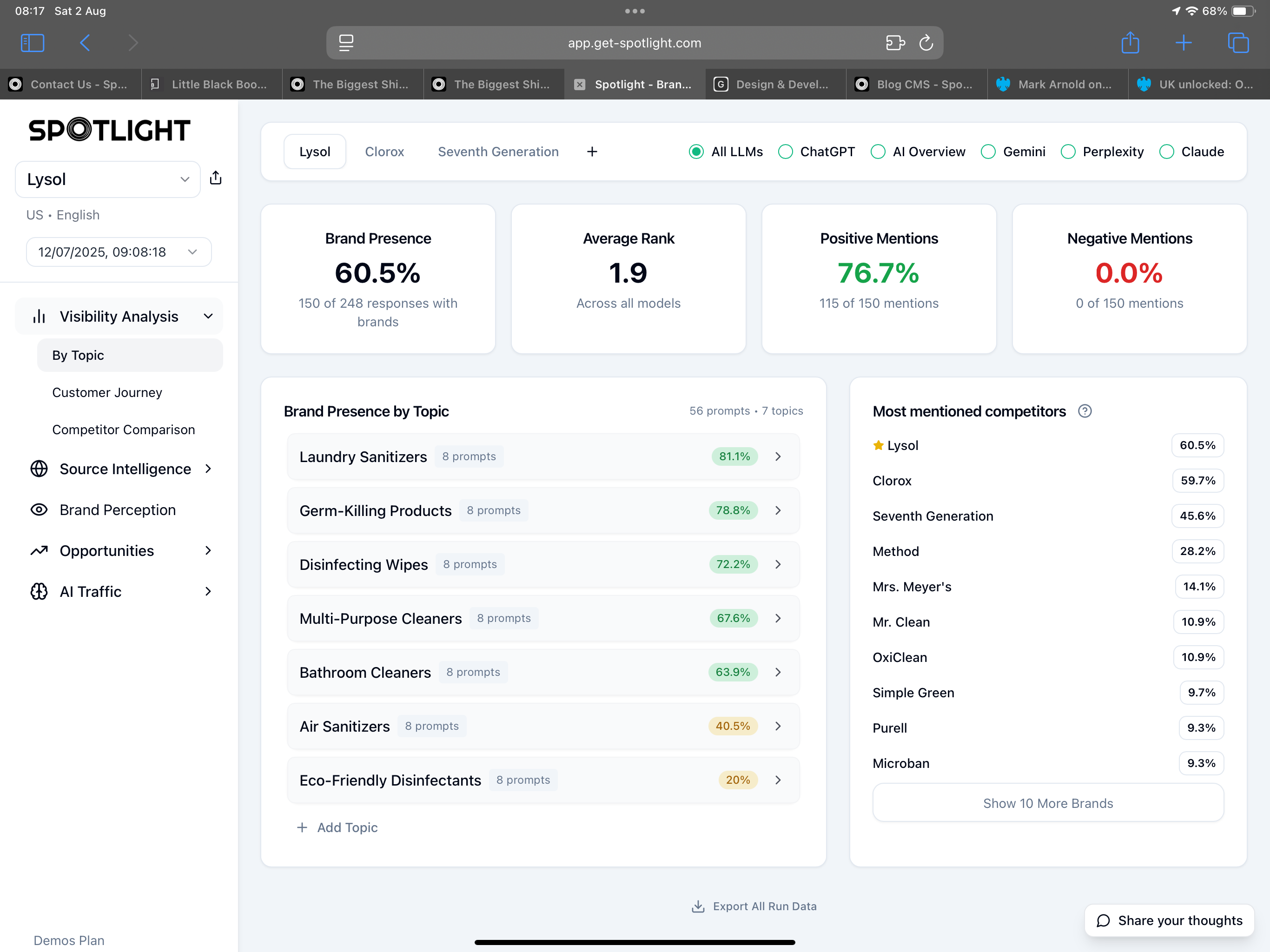
Citation Tracking changes that by providing a way to monitor how frequently a brand is referenced across AI-generated responses. Agencies can track whether visibility is increasing, identify which prompts are driving citations, and compare performance against competitors.
This creates a far stronger reporting narrative. Instead of simply saying that content has been optimized for AI search, agencies can demonstrate that a client’s visibility is growing across commercially valuable prompts and that their share of voice is improving over time.
Even when referral traffic remains relatively modest, those insights provide tangible evidence that optimization efforts are moving in the right direction.
What Tools Should You Use To Optimize Content for AI Search?
As AI assistants become a more common discovery channel, marketers need ways to measure both visibility and performance.
Website analytics remains an essential part of reporting, but it cannot capture the full impact of AI search on its own.
For years, pageviews, rankings, referral traffic, and conversions formed the foundation of most SEO reporting frameworks. Those metrics still matter, but they were designed to measure activity that takes place after a user reaches a website. AI search introduces a new challenge because some of the most valuable interactions may happen before a visit ever occurs.
This is why many agencies are beginning to combine analytics platforms with specialist AI search tools.
GA4 should remain the foundation of any measurement strategy. The introduction of AI Assistant reporting gives agencies greater visibility into how much traffic is arriving from AI platforms and what happens once users reach the site. This data is invaluable when connecting AI visibility to measurable business outcomes.
However, analytics platforms are only one piece of the puzzle.
They can tell you what happened after someone visited the website, but they cannot tell you how often a brand is being recommended, which prompts are generating visibility, or whether competitors are gaining more exposure within AI-generated responses.
This is where Spotlight fills an important gap.
Its prompt intelligence, fan-out query analysis, citation tracking, and visibility monitoring features help agencies understand performance beyond traffic metrics. Rather than focusing exclusively on visits and conversions, marketers can build a broader picture of how clients are appearing across AI ecosystems.
The combination is particularly powerful. GA4 helps demonstrate the measurable outcomes generated by AI traffic, while Spotlight helps explain why those outcomes are happening and where future opportunities exist.
Together, they allow agencies to move beyond surface-level reporting and build a much more comprehensive view of AI search performance.
Conclusion
Demonstrating ROI from AI search optimization requires agencies to broaden how they measure success.
As zero-click behavior becomes increasingly common, clicks and sessions alone can no longer tell the whole story. Visibility, citations, prompt coverage, and share of voice are becoming important indicators of performance alongside traffic and conversions.
The introduction of AI Assistant reporting in Google Analytics 4 is an important step forward, but traffic data on its own only provides part of the picture.
To understand the full impact of AI search, agencies also need visibility data. They need to know where brands are being cited, which prompts are driving exposure, and how that visibility compares to competitors.
By combining analytics data with Spotlight’s prompt intelligence, fan-out query analysis, and citation tracking capabilities, agencies can build a more complete understanding of AI search performance and demonstrate meaningful ROI to clients.
The agencies that adapt their reporting frameworks now will be better positioned to prove the value of AI search optimization and help clients compete as AI becomes an increasingly important part of the customer discovery journey.