Author: Heather Pears

  • AI Blind Spots: Why Startups Get Left Out of AI Answers — and What You Can Do About It

    AI Blind Spots

    When someone asks ChatGPT, Perplexity, or Gemini:

    “What’s the best CRM for early-stage startups?”

    Chances are they won’t hear about your company — even if your product is exactly what that user needs.

    This isn’t a failure of your marketing team. It’s a structural reality of how modern generative engines operate, and the implications are massive.

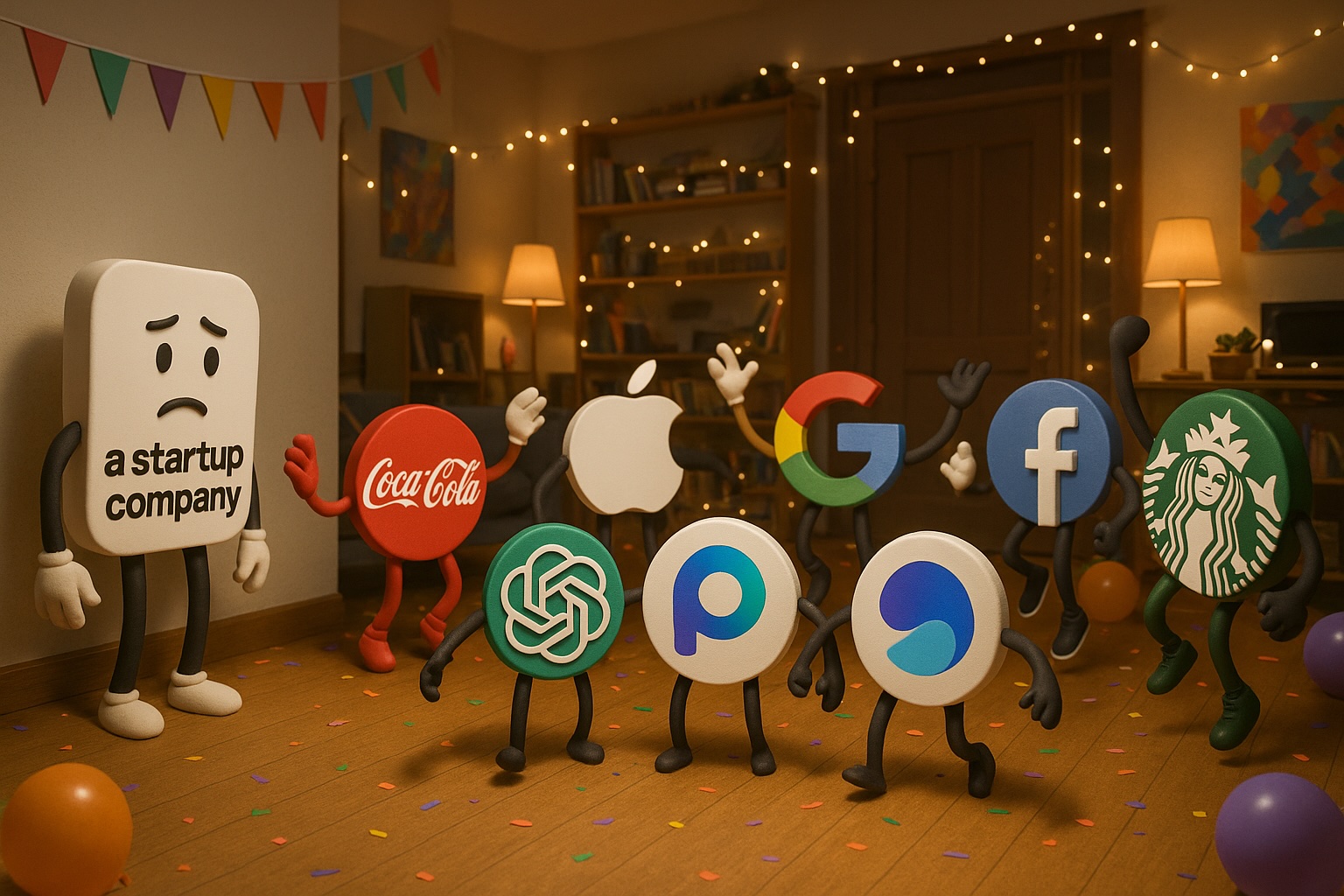
    As generative answers replace search results, visibility in AI engines is becoming a growth channel — and startups are at a natural disadvantage.

    Let’s unpack why that happens and what you can do to fix it.

    How AI Engines Actually Generate Answers


    Most generative search tools today operate in one of three ways:

    1. Static LLM answers (e.g., ChatGPT-4 without Browse):
      Responses are based solely on the model’s internal training data, which is often several months old and skewed toward popular, well-cited content.
    2. LLMs with real-time retrieval (e.g., Perplexity, Gemini, ChatGPT with Browse):
      These engines pull current content from the web and combine it with the model’s reasoning capabilities to construct answers.
    3. Hybrid models with source citations:
      These are increasingly common and provide direct links to the sources that shaped the answer — allowing users to verify claims.

    In all of these cases, whether the answer is drawn from static training data or real-time web search, the systems are only as good as the sources they can access and trust.

    Why Startups Get Left Out


    Even with real-time search, generative engines prioritize:

    • Sites they index frequently
    • Sources with structured, well-linked content
    • Brands with semantic proximity to relevant queries

    Most startups fail to show up because:

    • Their brand is rarely mentioned outside their own site
    • They’re not linked to in comparative or informative articles
    • They haven’t built the contextual relevance engines look for when assembling answers

    This creates a visibility gap — not because your startup lacks merit, but because AI systems simply don’t have the evidence they need to surface you with confidence.

    It’s Not a Visibility Problem. It’s a Context Problem.


    Generative engines don’t make editorial decisions. They work probabilistically. When asked for something like:

    “What are the best AI tools for customer support?”

    They surface names that:

    • Are mentioned in multiple high-authority sources
    • Are semantically linked to that category
    • Match the structure and intent of the query

    Startups that don’t show up in that retrieval process don’t make it into the answer.

    They aren’t ignored — they’re invisible.

    What You Can Actually Do About It


    Let’s skip the slogans. Here’s what moves the needle.

    1. Diagnose the Current State

    Ask real prompts:

    • “What are the best lightweight CRMs for startups?”
    • “Alternatives to HubSpot for solo founders?”
    • “What AI tools help early-stage teams close more deals?”

    Document:

    • Which companies are named
    • What sources are being cited
    • Which phrases or attributes those companies are tied to

    Or, use Spotlight to do this at scale — across hundreds of prompts and domains — so you can stop guessing and see exactly how your category is represented in generative engines.

    Spotlight isn’t just a visibility tracker. It’s a research engine. It reveals the sources, formats, and content patterns influencing AI-generated answers in your category — and shows you what to create to wedge your way in.

    2. Seed the Right Signals — in the Right Places

    Publishing on your own site isn’t enough. You need:

    • Content on third-party domains that generative engines trust (like G2, StackShare, Reddit, and high-authority blogs)
    • Comparative content that ties your brand to search-intent keywords (“best tools for…”, “alternatives to…”, “founder-friendly CRMs”)
    • Semantic bridges: Mentions of your product next to well-known competitors or in shared use-case contexts

    Think in terms of retrievability: will this content show up when an engine scrapes the web to answer a question?

    Tip: Generative engines love structured data — lists, tables, FAQs. Shape your content accordingly.

    3. Track and Iterate Like It’s SEO — But Faster

    This isn’t a one-time fix. Generative visibility is dynamic. What works today may not show up tomorrow.

    Use Spotlight to:

    • Track how often you appear in AI answers
    • See what’s driving mentions (and what’s not)
    • Monitor your competitors’ visibility over time

    Treat this like GEO: Generative Engine Optimization.
    It’s not traditional SEO — but the strategic logic is similar. And the window for early visibility is closing.

    The GEO Window Is Now


    We’re at the very beginning of the generative engine optimization race.
    Right now:

    • Most companies don’t know this game exists
    • The cost of getting in is low
    • There’s still time to shape how your category is defined in AI

    In 12 months, your competitors will be spending serious budget trying to rank in generative engines.

    The content will be more competitive.
    The link graphs more entrenched.
    The answers harder to influence.

    If you’re a startup, now is the moment to establish your AI presence — before the drawbridge lifts.
  • Google’s AI Overviews Cut Clicks by 34.5%

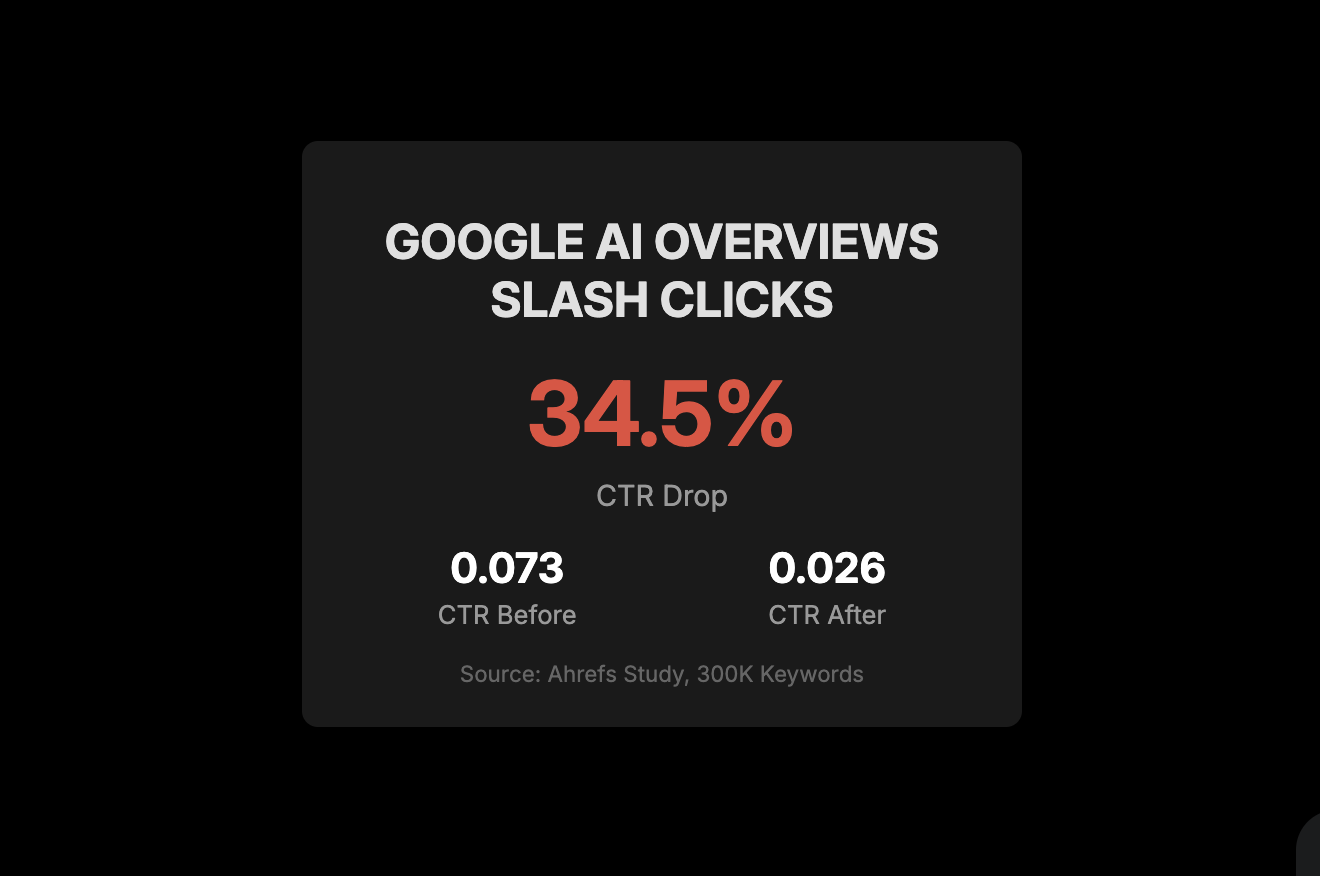
    New research from Ahrefs reveals that Google's AI Overviews significantly reduce clicks to websites. Their analysis of 300,000 keywords found that the presence of an AI Overview correlated with a 34.5% lower average clickthrough rate (CTR) for top-ranking pages.

    Google's AI overviews drops click rate by 34.5%

    The study compared clickthrough rates before and after the US rollout of AI Overviews:

    • For position one rankings with AI Overviews, CTR dropped from 0.073 in March 2024 to 0.026 in March 2025
    • For regular informational keywords, CTR fell from 0.056 to 0.031 in the same period

    This data directly contradicts Google CEO Sundar Pichai's claim that content within AI Overviews gets "higher clickthrough rates."

    Ahrefs' Director of Content Marketing, Ryan Law, notes this isn't surprising as AI Overviews function similarly to Featured Snippets by resolving queries directly in search results. He suggests clicks may reduce further as "the novelty wears off."

    Notably, Google still doesn't provide a way to see AI Overview performance separately in Search Console analytics.

    Source: Ahrefs: AI Overviews Reduce Clicks by 34.5%

  • Using AI? You need this Chrome Extension

    Let’s skip the foreplay.
    You’re buried.

    Beneath headlines, Slack threads, Zoom links, briefs that read like riddles, and deadlines that sprint faster than you do.

    Meanwhile, while you're keeping the lights on,
    AI is rewriting the rules.
    And it’s not asking your permission.

    By 2030, the LLM market alone is projected to balloon from $13.2 billion today to $49.9 billion.
    That’s a tectonic shift; and it’s already rumbling under your feet.

    Prompt Blaster puts you ahead of it.

    It’s a Chrome extension, sure.
    But it's also a truth serum, a spyglass, and a Molotov cocktail — depending on how brave you are.

    Prompt Blaster

    So, what’s it do?

    You write one prompt: just one.
    Prompt Blaster takes that single spark and fires it into every major LLM: GPT-4, Claude, Gemini, and the rest of the big dogs.
    Then it pulls their answers back: side-by-side, in real-time.

    No tab-hopping.
    No guesswork.
    No wondering if you’re winning or if your competitor is quietly eating your lunch.

    You see it all.

    You see how the machines — those trusted, tireless, whisper-in-the-ear machines — describe your brand.
    Or worse… how they describe your competitor.

    Why should you care?

    Because these models are no longer novelties.
    They are the front doors.
    The search engines.
    The gospel truth for your customers, your clients, and everyone in between.

    Already, OpenAI’s ChatGPT commands nearly 60% of the U.S. market.
    Microsoft Copilot? Another 14% — both powered by OpenAI.
    And fast-risers like Claude and Perplexity are seeing 10–14% quarterly growth, faster than anyone else.

    The battleground isn't coming.
    It's here.

    If GPT says your competitor is “a category-defining pioneer” and you’re “a company based in the UK,”
    congratulations; you just got flattened without even stepping into the ring.

    Here’s what Prompt Blaster lets you do:

    Stress test your messaging.
    Straplines. CTAs. Product blurbs.
    See what sings. See what stinks.
    Across every major model. In seconds.

    Spy on your competition.
    Run a prompt. Line up the answers.
    Watch who’s owning the narrative — and who’s bleeding out.

    Mine insights at the speed of thought.
    Brand audits, sentiment checks, press release dissections.
    Forget focus groups. Forget $20k research decks.
    The machines already know.

    Build custom prompt packs.
    Stop your team from reinventing the wheel.
    Start handing them race cars.

    Understand how the world sees you.
    Because today, it’s not your copywriter setting the tone.
    It’s the LLMs.

    No fluff. No fanboying over AI. Just raw leverage.

    Prompt Blaster doesn’t care if you're a CMO with a corner office or a junior planner living off bad coffee and big dreams.
    It gives you the same unfair advantage: clarity.

    And here’s the most important piece:
    Most brands aren’t watching what the models are saying yet.
    They’re sleeping on it.
    Which means if you move now, you’re early.

    By 2027? Being early won't be an option. It’ll just be the cost of staying alive.

    👉 Download the Prompt Blaster chrome plug-in
    Then fire off your first prompt and find out if you're the hunter or the hunted.

    If it doesn't shake something loose inside you, hell, maybe you deserve to be disrupted.

    But if it does?
    Congratulations.
    You just found your edge.

    Oh, and one more thing… did we mention it's free?
    For now.

  • AI Chatbot Market Share: April 2025

    Conversational AI Market Overview (April 2025)

    As of April 2025, the conversational AI market continues its remarkable growth. Recent analysis reveals OpenAI's ChatGPT maintains a dominant position, but emerging competitors like Perplexity and Claude show significant growth, hinting at potential market shifts.


    Current Market Share Distribution (April 2025)

    The following table details the estimated U.S. market share distribution for leading generative AI chatbots based on user numbers as of April 2025. Note that Microsoft Copilot, while listed separately, utilizes OpenAI's technology. [²]

    AI Chatbot Market Share Quarterly Growth Core Technology
    ChatGPT (OpenAI) 59.70% 8% ▲ GPT-3.5, GPT-4
    Microsoft Copilot 14.40% 6% ▲ GPT-4 (via OpenAI)
    Google Gemini 13.50% 5% ▲ Gemini Models
    Perplexity 6.20% 10% ▲ Mistral 7B, Llama 2
    Claude (Anthropic) 3.20% 14% ▲ Claude 3
    Grok (xAI) 0.80% 12% ▲ Grok 2, Grok 3
    Deepseek 0.70% 10% ▲ Proprietary
    Komo 0.60% 7% ▲ Proprietary
    Brave Leo AI 0.30% 6% ▲ Llama 2, Mixtral
    Andi 0.20% 4% ▲ Proprietary

    Market shares are based on U.S. user estimates. "AI Overviews" (associated with Google search) is not tracked separately and may be part of Google Gemini's data.
    Data source: First Page Sage [²]


    Market Share Trends (Jan 2024 – Mar 2025)

    Examining market share evolution over the past 15 months provides insights into competitive dynamics:

    • ChatGPT: Declined from 76.4% (Jan 2024) to 73.6% (Oct 2024), then stabilized around 74.1% by March 2025 (excluding Copilot).
    • Google Gemini: Fell from 16.2% (Jan 2024) to 13.3% (July 2024), with slight recovery to 13.7% (Mar 2025).
    • Perplexity: Doubled its share from 2.7% (Jan 2024) to 6.1% (Mar 2025).
    • Claude AI: Grew from 2.1% (Jan 2024) to 3.3% (Mar 2025).

    User Base and Growth Statistics

    While market share shows relative positioning, user numbers provide scale:

    • Google Gemini:
      ~67.29 million unique visitors (early 2025), supporting 46+ languages across 239+ countries. [³]

    • Claude AI:
      ~18.9 million monthly active users globally. Grew 300% from Dec 2023 to Dec 2024 (18.3M users), then adjusted to 16M in Jan 2025. Largest markets: U.S. and India. [⁴]

    • Perplexity:
      Surpassed 10M monthly active users by late 2023. Quadrupled adoption between Q2 2023 and Q1 2024. 38% of users are U.S.-based. [⁵]


    Market Growth and Projections

    • Conversational AI Market:
      Expected to grow from $13.2B (2024) to $49.9B (2030) — CAGR of 24.9%.
      Growth drivers: generative AI advances, integration with voice/vision, and preference for messaging-based customer service. [¹]

    • AI-Powered Search Segment:
      Valued at $3.2B (2023) → Forecasted $14.7B (2030) — CAGR of 24.5%.
      Broader AI search market may hit $50.3B by 2035. VC funding in AI search startups rose 147% in 2023. [⁵]


    Competitive Dynamics and Future Outlook

    While OpenAI technology (ChatGPT + Copilot) dominates with nearly 74% combined share [²], rapid growth from:

    • Claude: 14% quarterly growth
    • Grok: 12% quarterly growth
    • Perplexity: 10% quarterly growth

    …suggests a fragmenting and increasingly competitive market.

    Specialization Trends:

    • Perplexity: Accuracy-first, powered by Mistral 7B, Llama 2
    • Claude: Business-focused, using Claude 3

    Funding & Revenue:

    • Perplexity raised $73.6M, valuation $520M+ [⁵]
    • Claude AI reports $850M annualized revenue [⁴]

    As the market matures, key success factors will include accuracy, functionality specialization, and integration capabilities.


    Sources

    1. MarketsandMarkets – Conversational AI Market Research Report (Market Size & CAGR)
    2. First Page Sage – Top Generative AI Chatbots by Market Share – April 2025
    3. Doit Software – Google Gemini Statistics
    4. Backlinko – Claude AI Users & Revenue
    5. SEOSandwitch – Perplexity AI Stats, AI Search Market, Funding
  • AI is Replacing Traditional Search

    Recent data indicates a significant shift in how people search for information online, with many turning to AI tools instead of traditional search engines.

    AI replacing traditional search stats


    📈 Current Usage Trends

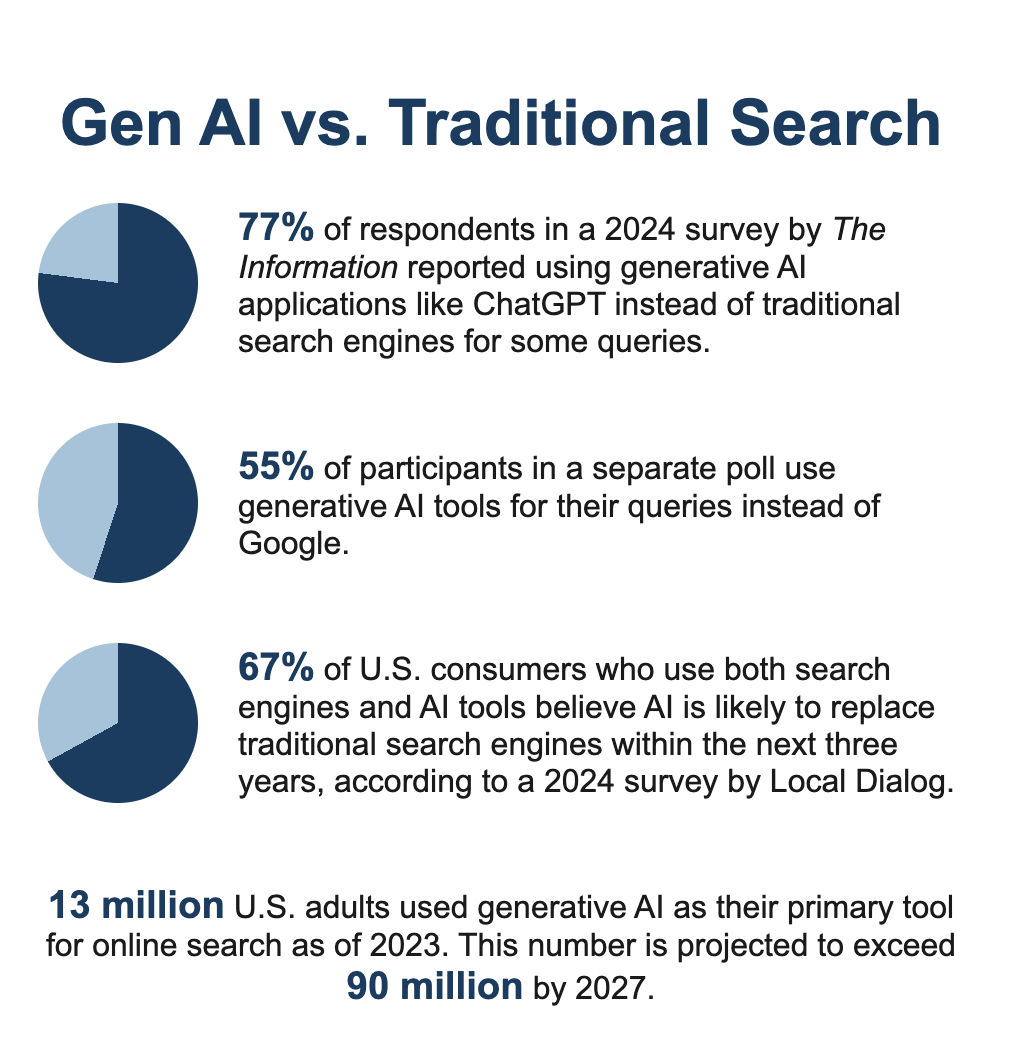
    • 77% of respondents in a 2024 survey by The Information reported using generative AI applications like ChatGPT instead of traditional search engines for some queries. [¹]
    • 55% of participants in a separate poll indicated they use generative AI tools for their queries instead of Google. [¹]
    • 67% of U.S. consumers who use both search engines and AI tools believe AI is likely to replace traditional search engines within the next three years, according to a 2024 survey by Local Dialog. [²]
    • 13 million U.S. adults used generative AI as their primary tool for online search as of 2023. This number is projected to exceed 90 million by 2027. [³]

    🔮 Future Projections

    • 25%Gartner predicts that by 2026, traditional search engine volume will decrease by 25%, with AI chatbots and virtual agents capturing a significant portion of search queries. [⁴]
    • 69% — By 2030, it's estimated that AI-driven tools could dominate over 69% of information searches, indicating a substantial shift towards AI-based search methods. [⁸]

    👥 Demographic Insights

    • 82% — AI search adoption is highest among younger Americans. For instance, 82% of Gen Z (ages 18–26) have used AI search tools at least occasionally, favoring social media for product discovery. [⁵]
    • 79.8% — Despite the rise of AI tools, 79.8% of consumers still prefer traditional search engines like Google or Microsoft Bing for general information searches. [⁵]

    💡 Implications

    The increasing reliance on AI for search suggests a transformative shift in user behavior, with potential impacts on industries reliant on search engine traffic. As AI tools become more integrated into daily life, businesses and content creators may need to adapt their strategies to maintain visibility and engagement.

    For brands, this shift means traditional SEO strategies must evolve. When AI is the intermediary between your brand and consumers, visibility depends not just on ranking well in search results but on being a trusted source that AI models reference.

    At Spotlight, we help businesses understand how AI talks about their brand and industry.
    Our platform analyzes the sources AI models reference when discussing your products or services, enabling you to craft strategies that ensure your brand remains visible in an AI-dominated information landscape.


    📚 Sources

    1. TechRadar: People are increasingly swapping Google for the likes of ChatGPT, according to a major survey
    2. StanVentures: The Search Revolution – How People Are Finding Information In 2025
    3. Statista: U.S. generative AI usage for online search forecast
    4. Gartner: Gartner Predicts Search Engine Volume Will Drop 25% by 2026
    5. Search Engine Land: AI search gaining traction but not replacing Google
    6. GWI: AI and search engine trends
    7. Exploding Topics: AI Statistics
    8. Morningscore: Will AI Grow Bigger Than Google Search?