Category: blog

  • Spotlight MCP Is Here: Connect ChatGPT, Cursor, n8n, and More to AI Visibility Data

    Spotlight now has an official Model Context Protocol (MCP) server. That means you can plug Spotlight into the AI tools and workflows you already use—so brand visibility, competitor context, and citation insights show up right where you work.

    If you are new to MCP, think of it as a safe, structured way for an app (like ChatGPT or Cursor) to call tools and read data from another product. The open MCP idea is described by the Model Context Protocol community documentation, and major AI platforms are adding support so assistants can do real work with your permission.

    What is the Spotlight MCP?

    The Spotlight MCP connects Spotlight’s analytics to compatible clients through a standard tool interface. Instead of copying charts into a doc, you can ask your assistant to pull the latest visibility readouts, compare brands, scan cited sources, and help you turn findings into next steps.

    This fits the same pattern companies like Anthropic describe for extending Claude with connectors—see Anthropic’s MCP overview for developers. Cursor also documents how to add MCP servers in the editor—see Cursor’s Model Context Protocol guide.

    Why should you connect Spotlight through MCP?

    Teams lose time when insights live in one tab and decisions happen in another. MCP reduces that gap. You keep Spotlight as the source of truth for AI visibility, while your assistant helps summarize, compare, draft, and route work.

    Which platforms can you connect to Spotlight?

    If a product supports MCP (or sits in a chain that does), you can connect it to Spotlight. Common examples teams ask for include:

    • Claude (and other assistants that support MCP)
    • ChatGPT and similar chat apps with connector-style integrations
    • Cursor for coding and content workflows in the IDE
    • n8n for automation and scheduled jobs
    • Lovable and other builder tools that can call MCP-backed tools
    • Notion for research hubs and meeting notes (often via an MCP bridge)
    • Google Sheets for lightweight reporting and shared scorecards
    • Slack for alerts and team summaries
    • And many more as the ecosystem grows

    Your exact setup depends on each product’s MCP support and your IT rules. The big win is the same: Spotlight data becomes callable from the tools you already live in.

    What can you do with the Spotlight MCP?

    Here are practical jobs the MCP can support. The list is not exhaustive—if you can describe it as a question about AI answers, sources, or trends, you can likely shape a workflow around it.

    • Check brand visibility across the models Spotlight tracks
    • Compare competitors on mentions, positioning, and momentum
    • Analyze cited sources to see which sites models trust in your category
    • Spot trends across models, topics, countries, and dates
    • Create custom reports tailored to a stakeholder (exec, content, PR, SEO)
    • Automate content creation by pairing insights with drafts in your editor
    • Automate outreach with structured briefs based on real gaps and prompts
    • Prioritize prompts where volume or opportunity is highest
    • Track sentiment shifts when narratives change week to week
    • Explain “why we lost this answer” with competitor and citation context
    • Turn gaps into a content calendar aligned to what models cite today
    • Monitor reputation prompts alongside standard visibility tracking
    • Build account health summaries for customer success and agency reviews
    • Feed Sheets or Notion databases for a single team dashboard
    • Trigger Slack alerts when a key topic moves materially

    How does this help marketing and SEO teams in plain terms?

    Generative engines do not work exactly like Google. People ask longer questions, models pull fresh web context, and answers change by platform. Spotlight already measures that world. MCP makes those measurements easier to use in planning meetings, sprint tickets, and agency workflows—without manual exports every time.

    For background on why citations and sources matter in AI answers, many public guides discuss retrieval and grounding concepts—see Google’s machine learning glossary entry on retrieval-augmented generation (RAG) for a short, neutral definition.

    What should you try first after you connect?

    Start with three simple prompts in your connected client: (1) “Summarize our visibility vs last month,” (2) “List the top cited domains for our top topic,” and (3) “Name three content gaps where we are absent but competitors appear.” Those exercises validate the connection and usually produce immediate action items.

    Frequently Asked Questions

    What is MCP in simple words?

    MCP is a standard way for an AI assistant to use tools and pull data from software you approve. It helps the assistant go beyond generic advice and work with your real metrics.

    Can I use Spotlight MCP with Cursor?

    Yes. Cursor supports MCP servers so you can keep Spotlight context next to code and content work. Follow Cursor’s MCP setup docs and add Spotlight using the configuration details Spotlight provides in your account materials.

    Does ChatGPT support MCP?

    Support depends on your ChatGPT plan and feature rollout. If MCP or compatible connectors are available in your workspace, you can attach Spotlight like other approved servers. If not, use a supported bridge tool or another MCP-capable assistant.

    How do I connect Spotlight to n8n, Notion, Sheets, or Slack?

    Most teams connect one MCP-capable “brain” (like an assistant or automation node) to Spotlight, then push results into Notion, Sheets, or Slack. The pattern is: pull structured insight from Spotlight, format it, route it to the tool your team already checks.

    Can Spotlight MCP compare my brand to competitors automatically?

    You can set up repeatable questions and workflows that compare brands across prompts, models, and time. The exact automation depends on the client you connect and your internal permissions.

    Will MCP replace the Spotlight web app?

    No. Think of MCP as an extra front door. The web app remains the home for deep exploration, while MCP helps you embed Spotlight into daily tools.

    Is it safe to connect Spotlight through MCP?

    Treat MCP like any integration: use official instructions, limit access to trusted devices, and follow your company security policy. MCP is designed to make tool access explicit rather than hidden.

    What is generative engine optimization (GEO) and why does MCP help?

    GEO is about improving how often and how fairly your brand shows up in AI-generated answers. MCP helps because it moves GEO metrics into the places teams already plan work, which makes actions happen faster.

    This post was written by Spotlight’s content generator.
  • The SEO Apocalypse Is Here. Your Website Is Officially Worthless.

    For two decades, the rules were simple: build a great website, master SEO, and wait for the traffic to roll in. That entire playbook was just thrown in the trash. A fundamental economic shift, powered by AI, has turned your company's most valuable digital asset into a free library for Google and OpenAI. But while most businesses are about to be wiped out, a new class of winners is quietly building empires on the rubble. Here's what they know that you don't.

    As generative AI commodities information, the only durable sources of economic value are proprietary data and authentic human trust.

    In February 2024, Stack Overflow, the canonical resource for a generation of software developers, announced a partnership to pipe its data directly into Google's AI models. For over a decade, the company’s value was predicated on being a destination. It was a place one visited, a digital commons where developers found answers. But this deal signalled a quiet, tectonic shift. Stack Overflow was acknowledging that its primary asset was no longer its traffic, but its structured archive of human expertise. It was no longer a destination; it was now a database.

    This had become a strategic necessity. Data from SparkToro, using Similarweb’s panel, shows that less than half of Google searches now result in a click to a third-party website, a staggering decline. Stack Overflow was facing the existential threat of its main user acquisition channel being consumed by the very aggregator it was now forced to partner with. This deal is a warning, it's a canary in the coal mine for the entire open web. It signals the end of discovery as a primary business model and the beginning of the era of the zero marginal cost of answers.

    The Answer is the Job

    For twenty years, the organising principle of the internet was the search engine, and the core "job-to-be-done" for a user was finding information. The search engine, however, never truly did the job; it was an intermediary, a powerful but inefficient one. It presented a list of potential solutions, forcing the user to do the final work of sifting through SEO-optimised articles to synthesise an answer. The entire digital media and marketing industry was built in the space between the query and the click.

    This model is being fundamentally challenged. Generative AI, for the first time, can solve the user's core job directly. It can synthesise the top ten search results into a single, coherent paragraph. It collapses the entire discovery and synthesis process into a single step.

    This is a classic disruption pattern, best understood through the precedent of Encyclopedia Britannica. Britannica’s business was never selling leather-bound books; its business was selling access to trusted, synthesised knowledge.

    When the internet and later Wikipedia provided a more efficient and eventually free solution to that core job, the value of the physical product evaporated. It did not matter that the books were beautifully made; the job they were hired to do had found a better, cheaper, faster contractor. Today, the content of the open web is the new encyclopedia, and generative AI is the new Wikipedia.

    To understand the consequences of this shift, we must apply the lens of Aggregation Theory.

    The New, Ultimate Aggregator

    Ben Thompson’s Aggregation Theory posits that power in the internet era accrues to the company that controls the user relationship while having zero marginal costs for serving those users and managing modularised, commoditised suppliers. Google was the first great aggregator of the open web. It owned the user relationship through its search bar and commoditised its suppliers, the millions of websites creating content, forcing them to compete for its traffic.

    Generative AI is the next logical, and perhaps final, step in this evolution. It is the ultimate aggregator.

    It has a direct relationship with the user, answering their questions conversationally.

    It has zero marginal costs for serving those users, as the cost per inference continues to fall dramatically.

    It perfectly commoditises its suppliers, not by merely ranking them, but by ingesting their content, synthesising it, and rendering the original source an implementation detail, a footnote, if that.

    This shift is collapsing the information value chain that defined the last two decades.

    The Old Value Chain: Create Content → Optimise for Discovery (SEO) → Attract Traffic → Monetise Traffic (Ads/Subscriptions). This was a circular system where aggregators like Google referred traffic to publishers.

    The New Value Chain: Ingest Content → Synthesise Answer → Deliver to User.

    This is a one-way street. Value terminates at the AI model.

    The recent deals between OpenAI and publishers like the Associated Press and Axel Springer are not partnerships of equals. They are the formal codification of this new power dynamic: the former aggregators of the open web are now relegated to the role of commoditised data suppliers to the new, more powerful aggregator. To see the stark financial impact, we simply have to follow the money.

    The Great Value Migration

    The business model of the open web was advertising, an economy built on the currency of attention. As clicks vanish, that economy is breaking. The first signs of this migration are already clear.

    In its February 2024 S-1 filing, Reddit celebrated a new, material revenue stream: $203 million in multi-year data licensing agreements with AI companies. This is a company whose primary asset for years was considered the traffic it could generate. It has now explicitly reclassified that asset as a proprietary data corpus to be licensed.

    The economics driving this are brutal and undeniable. For a significant and growing class of informational queries, the long tail of "what is" and "how to" questions that fuelled the content economy, the incentive structure for the aggregator has inverted. Consider the unit economics: the cost to generate an AI answer using an efficient model is now a fraction of a cent. Meanwhile, the average display ad revenue a publisher earns from a single pageview on an informational article is often less than half a cent. For these queries, it is now more profitable for the aggregator to provide a direct answer than to refer traffic, severing the value chain that once guaranteed publishers a role. While complex, high-intent commercial queries will still command valuable clicks, the foundational layer of the ad-supported web is being dissolved.

    The winners are those who own defensible, proprietary data. As Microsoft CEO Satya Nadella has stated, the competitive advantage in the AI era is "data gravity”, the unique, private data customers store in their platforms. This is why Microsoft’s moat is not just its partnership with OpenAI, but its entrenchment in the enterprise. It is why Adobe’s advantage with its Firefly model is its ability to offer legal indemnification because it was trained exclusively on its licensed Adobe Stock library, a proprietary dataset that guarantees its outputs are "commercially safe."

    The losers are undifferentiated content farms. The smart companies, however, are pivoting. They are transforming themselves from content destinations into data suppliers, just as Stack Overflow has done.

    Second-Order Effects: Citadels and Campfires

    This fundamental realignment has strange and far-reaching consequences.

    First, the balkanisation of the public web. As the highest-quality information is siloed into proprietary datasets, the open, searchable internet risks becoming a wasteland of low-quality, AI-generated content. Knowledge, once democratised, is being re-centralised behind API walls.

    Second, the rise of the "Data Refinery." A new B2B industry is emerging, focused not on content creation, but on cleaning, structuring, and verifying datasets for licensing to AI models. This is the new digital supply chain.

    Third, and most importantly, a new premium authentic human experience.

    When the marginal cost of producing a "good enough" summary approaches zero, the value of that which cannot be synthesised: authentic perspective, deep niche expertise, and community trust, skyrockets. This explains the resilience of the creator economy; in a world of infinite AI-generated noise, users seek out trusted human curators in "digital campfires" like Discord servers and Patreon communities.

    These cascading changes demand an immediate rethinking of corporate strategy.

    The Strategic Imperative: From Destination to API

    The strategic playbook for the last twenty years is being invalidated. For any company that operates a website, the imperative is to shift from building a destination to providing a structured data source.

    This can be visualised in a "Content Strategy Matrix for the AI Era," with axes for Data Uniqueness and Audience Relationship.

    Generic Data & Anonymous Traffic (The Dustbin): This quadrant, home to SEO-driven content farms, is becoming strategically indefensible.

    Proprietary Data & Anonymous Traffic (The Data Refinery): This is the position of Reddit or Stack Overflow. The strategy is to structure your archive and license it as a proprietary dataset, focusing on a new B2B customer: the AI model builders.

    Generic Data & Trusted Community (The Curator Brand): This is the position of trusted media brands. The strategy is to leverage brand trust to aggressively build a first-party data asset. Prioritize newsletter sign-ups over pageviews and convert anonymous followers into known subscribers. The direct, owned channel is a moat that cannot be aggregated by AI.

    Proprietary Data & Trusted Community (The Citadel): This is the strongest position, occupied by companies like Salesforce. The strategy is to build specialized AI models on this unique customer data to create defensible, high-margin products and deep customer lock-in.

    For brands, the website is no longer just a digital storefront to be decorated; it is an API to be maintained. Its primary customer is no longer just a human, but the AI models that mediate the world's information. The goal is no longer simply to attract eyeballs, but to provide clean, structured, and canonical data so that it can provide accurate answers about your products and services.

    The End of Abundance

    This entire shift is the expression of a timeless principle: technology always commoditises what is abundant to increase the value of what is scarce. The first era of the internet made the distribution of content abundant, creating immense value for aggregators like Google. This new era of generative AI is making the creation of content abundant.

    The new scarcities, therefore, are the only two things AI cannot manufacture: proprietary, high-quality data and authentic human trust.

    The open, discoverable web built by Google may have been a temporary, twenty-year phase, an accident of technological limitations. We are now entering an era defined by data citadels and trusted digital campfires. Companies that understand this will build the next generation of value. Those that continue to compete for clicks are playing a game that has already been lost.

  • Which brands offer comprehensive visibility tracking for AI conversations?

    TLDR
    Plenty of tools watch what large language models say about your brand. Very few help you change it. Comprehensive means five things. Multi-model coverage. Citation and source analysis with share-of-voice. Sentiment and competitor benchmarking. Scheduled, repeatable runs with prompt and model transparency. And a feedback loop that turns visibility shifts into concrete content and data fixes that improve results [1][2].

    What AI conversation visibility means
    AI visibility platforms run controlled prompts across engines such as ChatGPT, Claude, Gemini, Perplexity, and Google AI Overviews. They capture the responses, check if you are mentioned, assess how you are positioned, examine which sources were used, and compare you with competitors [1]. Google’s own position is that SEO best practices still apply. There is no markup to force your way into AI answers. That means the quality and clarity of your content is what matters. Monitoring shows where you stand. Content and data improvements move you [2].

    How we defined comprehensive
    A platform is comprehensive if it covers multiple models, shows which sources and citations drive answers, tracks rank and share-of-voice, benchmarks sentiment and competitors, runs on a transparent and repeatable schedule, and closes the loop by turning insights into recommendations with measurement built in.

    Who covers the bases in 2025
    Spotlight (get-spotlight.com). What it is. A customizable platform built specifically for LLM visibility. It tracks mentions, positioning, sentiment, and citations across major AI engines. It turns this into clear recommendations and then allows you to measure your experiments. It closes the loop from visibility to insight to content recommendations to measurement and back again [3]. Best for: Teams that want closed-loop LLM SEO instead of dashboards alone.

    Wix AI Visibility Overview. What it is. A GEO module that monitors citations, sentiment, competitor visibility, and AI-driven traffic and query volume. Users can customize question sets and see which sources contribute to the answers [5][6][7]. Best for: Brands on Wix that want native AI visibility and traffic indicators.

    Semrush Enterprise AIO / AI SEO Toolkit. What it is. A suite that automates prompts, captures responses, and benchmarks mentions, position, and sentiment across ChatGPT, Claude, and Google AI Overviews. It layers optimization guidance on top of traditional SEO analytics [1][8]. Best for: SEO and content teams that want AI visibility within an established analytics stack.

    Adobe LLM Optimizer. What it is. A capability inside Adobe Experience Cloud that tracks AI-driven traffic, benchmarks visibility across chat and browsers, and produces recommendations to improve brand presence. It supports ChatGPT, Gemini, and Claude, with enterprise governance and ROI framing [9][10][16]. Best for: Enterprises already in Adobe’s ecosystem that want governance plus optimization.

    Otterly. What it is. A monitoring platform that reports on brand mentions, visibility, sentiment, competitors, and links across ChatGPT, Perplexity, and Google AI Overviews. It is also available as a Semrush App Center integration [15][18][19]. Best for: Teams that want lighter-weight monitoring connected to Semrush reporting.

    How to buy without getting burned
    Buying an AI visibility platform is not about a quick test. You need to know if it can be the backbone of your LLM SEO work for the long haul. Ask these questions before you commit.

    Does it fit your workflow
    If the interface feels heavy and only suits engineers, it will fail. Non-technical users should be able to use it. Can you turn insights into briefs or exports fast. Does it connect with your content and analytics stack or does it sit as a silo.

    Can you shape prompts to match your customers
    Every brand faces different customer tasks. You need flexibility. Can you adjust or localize prompts to reflect real questions. Does the vendor show which prompts they use, how often they are refreshed, and whether you can segment them by product, market, or language.

    How transparent is model coverage
    It is not enough to say “we monitor AI.” Which models are covered. ChatGPT, Gemini, Claude, Perplexity, Google AI Overviews, Copilot, Grok. Can you filter results by model, topic, and content format.

    Do you see how answers are formed
    Checking if you are mentioned is the baseline. The value is in the why. Which sources and citations are used. What your share-of-voice is. What the sentiment shows. Can you trace missing mentions back to content gaps.

    Does it move from monitoring into action
    Dashboards alone do not help. Strong tools turn insights into briefs. Are recommendations precise or is LLM best practice embedded into the platform to create targeted briefs or to recommend how to adapt your existing content? Or are they vague such as “improve authority.”

    Can it prove your actions worked
    Once you act, the platform should show if visibility, sentiment, and citations improve. Does it track movement across time, markets, and competitors. Can results be tied to KPIs that matter such as traffic quality, share-of-voice lift, or cost of acquisition.

    Spotlight clears this bar. It closes the loop from visibility to insight, to recommendations, to measurable impact, and back again. This cycle improves how LLMs talk about your brand and shows if the work is paying off.

    Bottom line
    If you only watch AI conversations, you will measure decline instead of changing it. Choose a platform that closes the loop. Spotlight is the clearest closed-loop posture today. Wix, Semrush, and Adobe add strong productized layers depending on stack. Otterly offers lighter coverage. Invest only where visibility translates into action [3][5][1][9][15][17].

    References

    [1] Semrush. “The 9 Best LLM Monitoring Tools for Brand Visibility in 2025.” https://www.semrush.com/blog/llm-monitoring-tools/

    [2] Google Search Central. “AI Features and Your Website.” Last updated 2025-06-19. https://developers.google.com/search/docs/appearance/ai-features

    [3] Spotlight. “Brand Visibility in AI conversations.” https://www.get-spotlight.com/

    [5] Wix Press Room. “Wix Launches AI Visibility Overview With Full Generative Engine Optimization Support for AI-Powered Search.” 2025-07-16. https://www.wix.com/press-room/home/post/wix-launches-ai-visibility-overview-with-full-generative-engine-optimization-support-for-ai-powered

    [6] Wix Help Center. “Wix Analytics: About the AI Visibility Overview.” https://support.wix.com/en/article/ai-visibility-overview

    [7] TechRadar. “Wix introduces a new tool to optimize sites for AI.” https://www.techradar.com/pro/website-building/wix-introduces-a-new-tool-to-optimize-sites-for-ai

    [8] Semrush. “LLM Optimization (LLMO): Get AI to Talk About Your Brand.” https://www.semrush.com/blog/llm-optimization/

    [9] Adobe Newsroom. “Adobe LLM Optimizer Empowers Businesses to Drive Brand Visibility.” 2025-06-16. https://news.adobe.com/news/2025/06/adobe-llm-optimizer-empowers-businesses-drive-brand-visibility

    [10] TechRadar. “Forget about SEO – Adobe already has an LLM Optimizer to help businesses rank on ChatGPT, Gemini, and Claude.” https://www.techradar.com/pro/security/forget-about-seo-adobe-already-has-an-llm-optimizer-to-help-businesses-rank-on-chatgpt-gemini-and-claude

    [15] Semrush App Center. “Otterly – AI Search Monitoring.” https://www.semrush.com/apps/otterly-ai-search-monitoring/

    [16] Adobe for Business Blog. “Boost brand discovery in AI search with Adobe LLM Optimizer.” 2025-06-16. https://business.adobe.com/blog/introducing-adobe-llm-optimizer

    [17] BrandBeacon Platform. “AI Search Brand Monitoring & Analytics.” https://www.brandbeacon.ai/platform/monitor

    [18] Otterly.ai. “AI Search Monitoring Semrush App.” https://otterly.ai/ai-search-monitoring-semrush-app

    [19] Otterly.ai. “Otterly – AI Search Monitoring.” https://otterly.ai/

  • The Great Decoupling: Why SEO as We Knew It Is Over

    For more than two decades, search engine optimization (SEO) functioned like a map. It told marketers where to go, how to be found, and what to tweak to climb the ranks of Google’s algorithmic ladder. It was, in many ways, predictable. The rules changed, yes; but gradually, and often transparently.

    Then came generative AI. And the map was set on fire.

    Today, we are entering what industry leaders have begun calling the era of Generative Engine Optimization (GEO). This shift is structural. GEO acknowledges a new kind of search engine, one that doesn't direct traffic to links, but builds answers from them. Large Language Models (LLMs) like ChatGPT, Claude, Gemini, and Perplexity are absorbing knowledge, synthesizing responses, and reshaping how consumers discover and evaluate information.

    In short: Google is no longer the only gatekeeper. And the implications for business, marketing, and digital strategy are immense.

    A New Type of Search Demands a New Strategy
    Traditional SEO focused on optimizing a brand’s owned web properties. Rankings were earned through backlinks, keyword density, site speed, mobile usability, and domain authority. And while those levers still matter, they are no longer sufficient in a world where AI tools answer questions directly.

    GEO represents a more fragmented, multi-platform approach. As marketing strategist Neil Patel puts it, success now requires a "search everywhere" strategy; one that treats forums, directories, social channels, and third-party content as equally important nodes of discoverability. Content that lives only on your site may never be seen by an AI-powered engine synthesizing answers from across the internet.

    Where SEO was about ranking, GEO is about remembering; being remembered by the model, cited by it, and trusted enough to be surfaced in its answers.

    The Great Decoupling: Impressions Without Clicks
    One of the clearest consequences of this shift is what many are calling The Great Decoupling; the growing disconnect between impressions and clicks.

    In the past, high search impressions often translated into traffic. But today, even if your content is cited in an AI answer, that doesn't guarantee a click. In fact, users often find everything they need in the AI-generated summary and never visit your site at all.

    Google Search Console data bears this out. Impressions are climbing. Clicks are flattening or falling. But that doesn’t necessarily mean brands are losing. In many cases, the users who do click are more informed, more targeted, and more likely to convert. The game has changed. It’s no longer about traffic. It’s about intent.

    Three Pillars of Visibility in the AI Era
    Winning in the age of generative search requires adapting, not abandoning, the core principles of SEO. But it also demands building new muscles. Below are the foundational elements every business should master:

    1. E-E-A-T as Competitive Differentiator
      Experience. Expertise. Authoritativeness. Trustworthiness. Introduced by Google and now adopted across multiple AI search platforms, E-E-A-T is fast becoming the cornerstone of content quality. It rewards those who can prove domain expertise through depth, credibility, and citation.

    Why does this matter? Because generative models are flooded with content. What sets yours apart is who it's attributed to. Content connected to a recognized voice or expert; especially one cited across multiple sources has a significantly higher chance of being selected by AI systems.

    1. Domain Authority Still Matters, but Differently
      Tools like SE Ranking and Moz have long tracked domain authority, scoring websites on a 100-point scale. A higher score indicates greater trust and credibility. But in the age of GEO, this authority is not enough on its own. What matters is how often your content is cited outside your domain and how clearly your expertise echoes across the digital ecosystem.

    Being an island of authority isn’t enough. You need to be part of the knowledge graph.

    1. Hybrid Content Creation
      AI can accelerate production. But human insight remains irreplaceable. The most effective content today is created with a hybrid model: using AI to generate research, structure, and repetition and humans to inject originality, nuance, and voice.

    Brands are now developing their own micro language models; AI systems trained on brand tone, values, and expertise. The result? Scalable content that feels handcrafted.

    Actionable Strategies for the GEO Landscape
    To build visibility in this new environment, here’s how marketers are adapting their toolkits:

    Create 10x Content: Instead of publishing 10 average articles, invest in one piece that’s 10x better than anything else available on the topic. Then repackage it across platforms—turn it into LinkedIn posts, Reddit threads, YouTube explainers, or Quora answers.

    Use Platforms Like Featured.com: Getting quoted by journalists and high-authority outlets boosts both E-E-A-T and discoverability. It positions your voice in places LLMs are trained to trust.

    Target the Right Directories: Not every directory matters. But the ones that rank for your keywords? They’re powerful. If Google ranks them, so will the models. Add your business there.

    Track the LLM.txt Standard: While not yet adopted universally, LLM.txt is a proposed protocol that allows brands to guide AI crawlers—like robots.txt but for models. Keep it on your roadmap.

    Run LLM Visibility Audits with Spotlight: Tools like Spotlight give brands a clear, data-backed view of how often they appear in AI-generated responses across ChatGPT, Gemini, Claude, and others. It’s like having Google Search Console; but for generative engines. With visibility, citation tracking, source attribution, and competitive benchmarking, Spotlight helps marketers see what the models see and fix what’s missing. If you don’t know how you’re showing up, you can’t shape the answer.

    The Data: Five Trends You Can’t Ignore
    This transformation isn’t hypothetical. It’s visible in the data. Here are five trends reshaping how visibility is earned:

    Organic Clicks Are Disappearing: AI Overviews push traditional results further down the page. According to Authoritas, brands can lose up to 79% of traffic when displaced by AI summaries. A Pew study found that only 1% of users click links inside AI Overviews.

    Gen Z is Leading the Shift: A Gartner study reports that 70% of Gen Z regularly use generative AI tools. These users expect answers, not links. Optimizing for traditional search alone ignores the future customer base.

    E-E-A-T Drives AI Citations: Research shows content that includes quotes, sources, and first-person expertise is 40% more likely to be cited by LLMs. Your voice is your ranking factor.

    Zero-Click Is the New Normal: A SparkToro study found that 58% of Google searches now end without a click. AI is accelerating this trend. The implication? Get cited, or get forgotten.

    Cross-Platform Discovery is Rising: The average user now spends time on 7+ digital platforms each month. TikTok, YouTube, and Reddit are fast becoming primary discovery tools. Search is now a distributed conversation.

    The Path Forward
    The brands that succeed must resonate. They’ll show up not because they gamed the system, but because they’ve been woven into the model’s understanding of what matters.

    This is not the end of SEO. It’s the beginning of something bigger.

    And in this new world, you won’t be rewarded for simply existing. You’ll be rewarded for being known.

    Stats and Data:

    Pew Research Center: The source for the statistic that users clicked on a cited link in an AI Overview only 1% of the time, and that AI Overviews made users almost half as likely to click on links compared to a search page without one.

    SparkToro: The source for the data on "zero-click" searches. A study found that over 58% of Google searches are "zero-click," with users finding their answers directly on the search results page.

    Gartner and Salesforce: The source for the statistic on generational adoption of AI. A survey found that 70% of Gen Z have used generative AI tools.

    Authoritas: The source for the finding that a site previously ranked first could lose up to 79% of its traffic when results for that query are delivered below a Google AI Overview.

    Metricool and Backlinko: The source for the statistic on social media usage. The average person uses nearly 7 different social networks per month, and users on TikTok spend an average of 35 hours per month on the platform.

    Sources:

    https://www.pewresearch.org/short-reads/2025/07/22/google-users-are-less-likely-to-click-on-links-when-an-ai-summary-appears-in-the-results/

    https://sparktoro.com/blog/2024-zero-click-search-study-for-every-1000-us-google-searches-only-374-clicks-go-to-the-open-web-in-the-eu-its-360/

    https://explodingtopics.com/blog/generative-ai-stats

    https://www.waltonfamilyfoundation.org/gen-z-is-adopting-ai-and-asking-for-guidance

    https://humanmade.com/wordpress-for-enterprise/how-ai-summaries-are-changing-web-traffic-patterns/

    https://medium.com/@iitkarthik/ai-summaries-causing-a-devastating-traffic-collapse-sites-ranked-1-can-lose-up-to-79-of-792fcf9c422b

    https://backlinko.com/social-media-users

    https://www.seo.ai/blog/how-many-people-use-social-media

    https://metricool.com/social-media-statistics-to-know/

  • The Lysol vs. Clorox Showdown: What 2 Legacy Brands Taught Us About Winning in the Age of AI Search

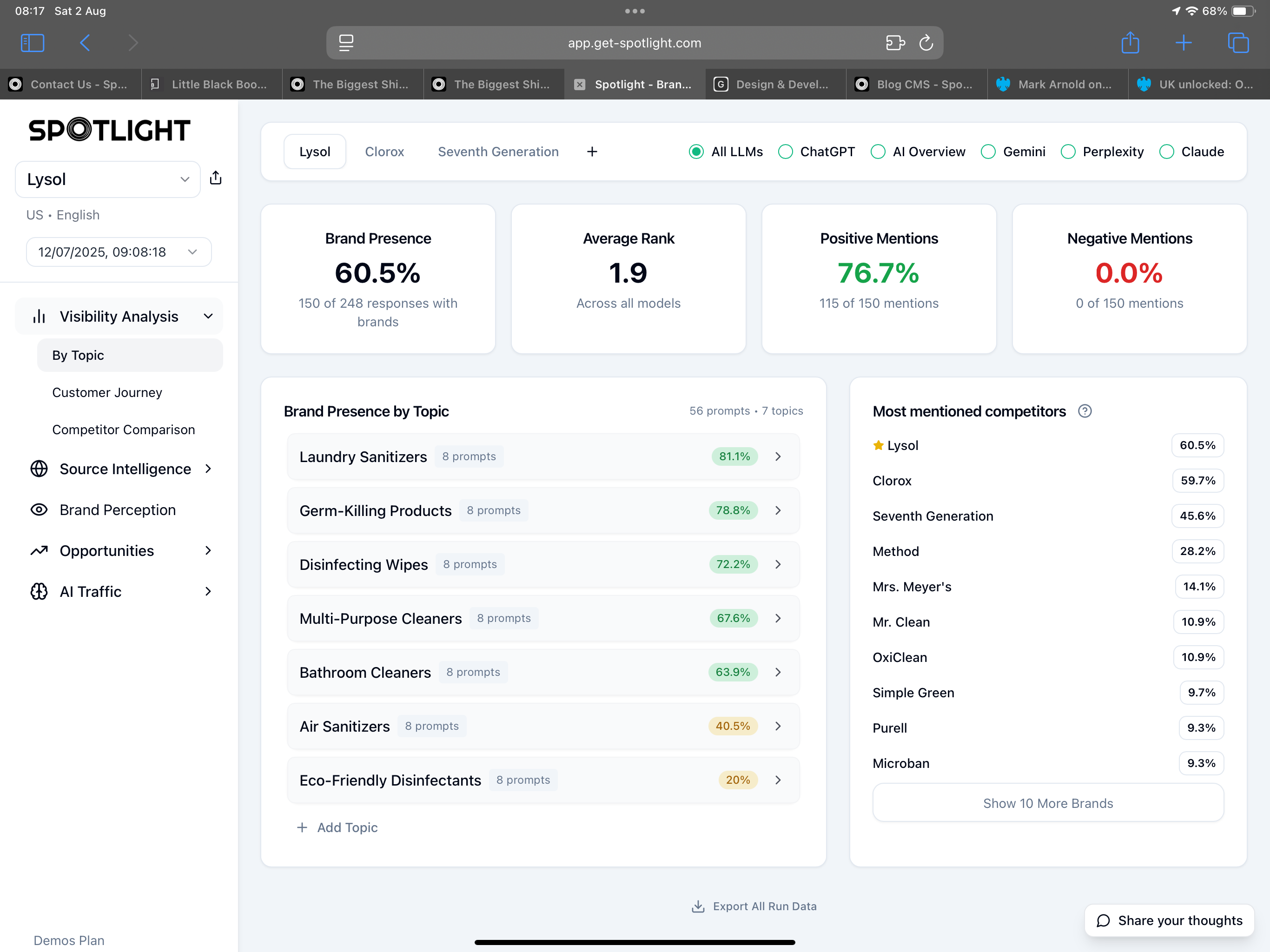
    We ran a full-spectrum LLM visibility analysis on Lysol and The Clorox Company ; two legacy brands battling for dominance in the cleaning aisle.

    What we found changes how we think about content, rankings, and AI relevance.

    1. Presence isn’t dominance. Ranking is.

    In ChatGPT, AI Overviews, Claude Gemini, and Perplexity:

    Clorox appears in 59.7% of branded responses.
    Lysol? Slightly higher at 60.5%.
    But Lysol ranks #1 in 76.7% of its mentions; outperforming Clorox on positioning across high-intent prompts.

    Implication: It’s not how often you’re seen; it’s where and how you show up. Authority and context relevance beat frequency.

    This aligns with findings from OpenAI’s system card (2023): LLMs weight content quality and source reputation more heavily than simple occurrence volume.

    1. Sentiment is the new domain authority.

    76.7% of Lysol mentions across LLMs are positive.
    Clorox sits flat at 50%.
    And no; this isn’t just tone. Positive mentions correlated with higher rank and more citations.

    See: Budzianowski & Vulić (ACL 2022) on how LLMs internalize and replicate evaluative sentiment across outputs.

    1. You’re invisible in the places that matter.

    Our study found 48 high-intent prompts (e.g., “What are the best disinfectant wipes?”) where Clorox shows up; and Lysol doesn’t.

    Despite being a market leader.

    This is the SEO equivalent of a brand blackout.

    Takeaway: LLMs don’t crawl your sitemap. They synthesize based on the sources they trust. If you’re not there, you don’t exist.

    1. 49% of LLM citations didn’t link to the brand at all.

    They cited the product. The ingredient. The use case.

    No URL. No domain. No visibility.

    This “ghost visibility” creates brand lift with no traffic return.

    Fix: LLM-optimized content must serve two masters; semantic relevance and verifiable authority.

    1. The top LLM-cited sources for Lysol weren’t even brand-owned.

    EPA.gov
    Consumer Reports
    Good Housekeeping
    These three alone accounted for 80+ citations in AI-generated answers.

    Lesson: If you’re not controlling the narrative, someone else is. And the AI is listening to them.

    Three experiments to run now:

    (1) Citation Hijack

    → Scrape the top 50 prompts in your category. Identify the top 10 non-owned citation sources. Partner, guest-post, or get reviewed.

    (2) Prompt Coverage Mapping

    → Run a content audit. Identify your no-show prompts. Build content to directly answer the language users are using with AI.

    (3) Sentiment Optimization

    → Fine-tune tone, structure, and authority signals. Use trusted studies, quote institutions, and eliminate hedging.

    This is what LLM SEO looks like in practice:

    Not pageviews.
    Not backlinks.
    Prompt-level perception management.

    Want to see how your brand’s performing? We’ll build your AI Visibility Snapshot for free. No pitch. Just proof.

    http://get-spotlight.com/free-report/

    #LLMSEO #MarketingStrategy #AIContent #Spotlight #BrandStrategy #SearchIsChanging #AcademicMarketing

  • Cheil UK and AI startup Spotlight forge strategic partnership to power brand discovery in the age of AI

    London, 31st July 2025 – Integrated digital marketing and advertising agency Cheil UK has today announced a strategic partnership with Spotlight, an enterprise startup focused on brand visibility and performance in an AI-driven search landscape. The collaboration will see Cheil UK and Spotlight collaborate on a next-generation platform that helps brands navigate the growing influence of large language models (LLMs) on digital discovery.

    The partnership is grounded in ongoing collaboration, with Spotlight able to adjust its roadmap inline with Cheil’s insights and client needs. Spotlight will work closely with Cheil’s global development and strategy teams to co-create proprietary tools designed to future-proof brand visibility. The new platform combines Spotlight’s LLM SEO expertise with Cheil’s broader marketing technology capabilities.

    The move reflects a shift in how consumers discover and engage with brands. As LLMs increasingly shape what users see and believe, the platform will enable brands to manage how they appear in AI-powered environments. Spotlight is developing new capabilities informed by Cheil’s client priorities, giving them early access and strategic influence, while building solutions applicable to the wider market.

    The platform is being developed in close collaboration between the two businesses, with teams from both sides working on areas such as prompt engineering, brand voice optimisation, AI-driven content systems, and integration into Cheil’s wider tech infrastructure. Cheil clients will receive early access to the platform, including onboarding support, beta features up to six weeks before public release, API integrations, and dedicated support channels.

    This partnership is part of Cheil’s wider investment in AI innovation across its services, from digital and content to retail and e-commerce. The Cheil x Spotlight platform will sit alongside other AI-powered tools developed by the agency to support connected, scalable marketing solutions.

    Cheil UK and Spotlight are also forming a cross-company innovation council to co-develop more products.

    Chris Camacho, CEO of Cheil UK, said: “This is not about bolting AI onto old ways of working. It’s about building the future from the inside out. Our clients need tools designed for the way the world is changing. Spotlight shares our urgency and ambition. This partnership marks a new phase in AI-led marketing development, helping brands take a leading role as search and discovery models continue to evolve.”

    Michael Hermon, CEO of Spotlight, added: “Partnering with Cheil means building alongside a global leader that understands what innovation looks like. Together we’re defining what LLM-native marketing means – both for today’s platforms and tomorrow’s consumers.”

    Notes:

    About Cheil UK
    Cheil UK is an integrated digital and advertising agency bridging physical, digital, and immersive experiences. With a commitment to pushing innovation, Cheil works with progressive brands like Samsung to optimise the edge across technology, retail, and emerging sectors, helping brands forge deeper, more rewarding customer experiences.

    About Cheil Worldwide
    Cheil Worldwide is the leading business-connected agency operating in 45 countries worldwide with around 6,500 employees. We specialise in performance-driven marketing across three core offerings – brand communications, experiential, and commerce. With our focus on enhancing business performance of our clients and brand experience of consumers, we create connected experiences that matter by forging connections between all the marketing silos, putting together creativity, data, tech, and retail. Our global network includes Cheil Worldwide, Barbarian, BMB, Cheil Centrade, Cheil PengTai, ColourData, Experience Commerce, Iris, McKinney, and One RX.
    About Spotlight

    Spotlight is the first platform built to help brands measure, understand, and grow their presence inside Large Language Models (LLMs) like ChatGPT, Google AI OverviewsClaude, Gemini, and Perplexity. By fusing real-time LLM outputs with Google Search Console data and competitive benchmarking, Spotlight reveals where your brand shows up in AI-generated answers and where it doesn’t. But it doesn’t stop at insights. Spotlight is the only platform that not only identifies content gaps but also tells you exactly what to do about them and then tracks whether it worked.

    By analyzing the actual sources LLMs use to form their answers, Spotlight uncovers the hidden structure of LLM-optimized content: preferred formats, ideal length, use of citations, authorship signals, semantic layout, and more. It surfaces the patterns across hundreds of thousands of high-performing pages to reverse-engineer what the models prioritize.

    These insights are then transformed into robust, ready-to-use content briefs; giving your team a blueprint for creating LLM-friendly content that is not only optimized, but strategically structured to rank. From there, Spotlight continuously monitors how and when your new content is picked up by LLMs, closing the loop between strategy, creation, and real-world impact.

  • How to replace your data analyst with Cursor and AI (in 20 minutes)

    How to replace your data analyst with Cursor and AI (in 20 minutes)


    Last week I spent 35 minutes interviewing a data analyst… and barely scratched the surface of how our platform and database work.
    Huge waste of time.

    In those same 35 minutes, I could’ve built a fully working web app end-to-end with AI—while having breakfast.

    So I thought: What if I just unleash AI on data analysis?
    Turns out… you can.

    My goal: Extract actionable insights from Spotlight’s massive database of AI prompts, responses, brand mentions, cited websites, and more—for better brand visibility.

    Here’s exactly how I did it:


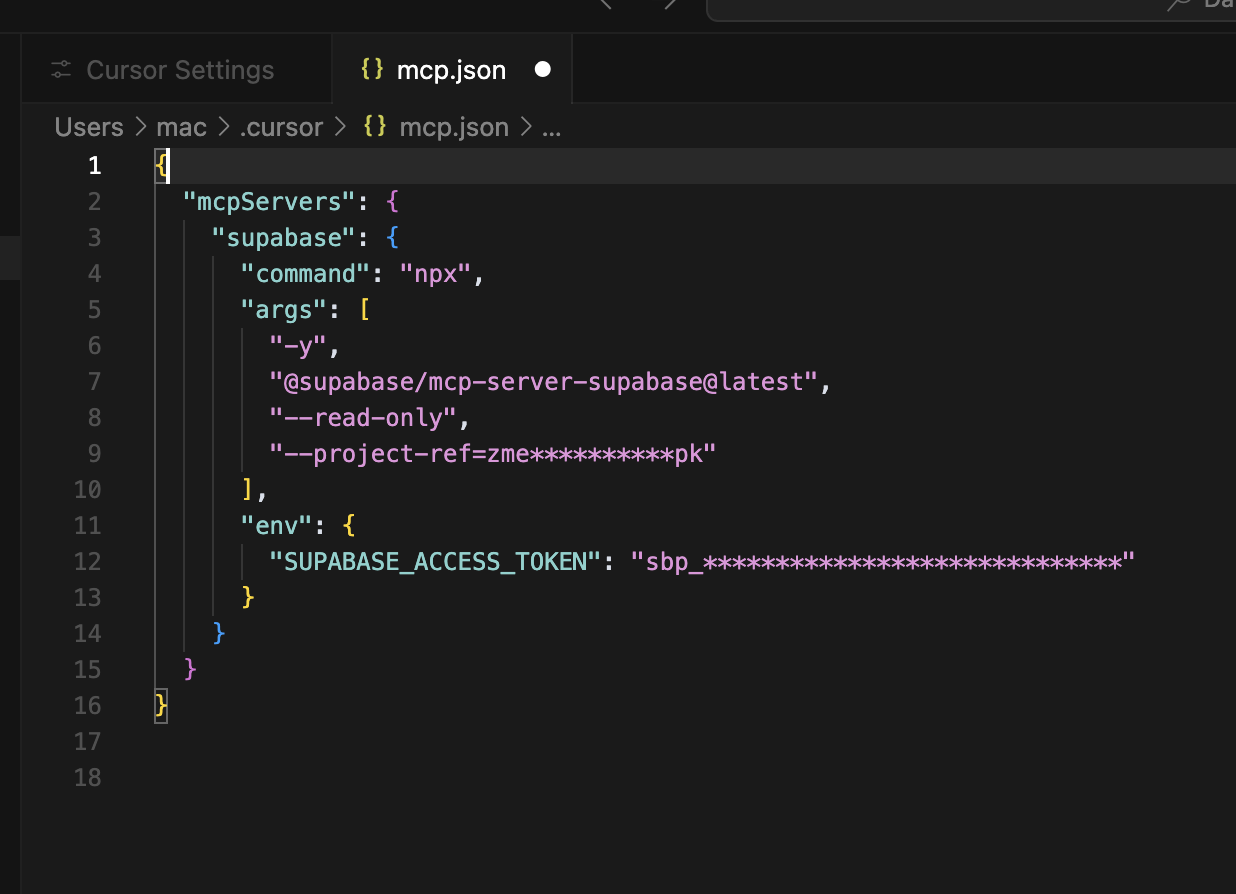
    1. Connect Cursor to Your Database via MCP

    • Download Cursor (any AI IDE like Windsurf should work too).
    • In Cursor, head to:
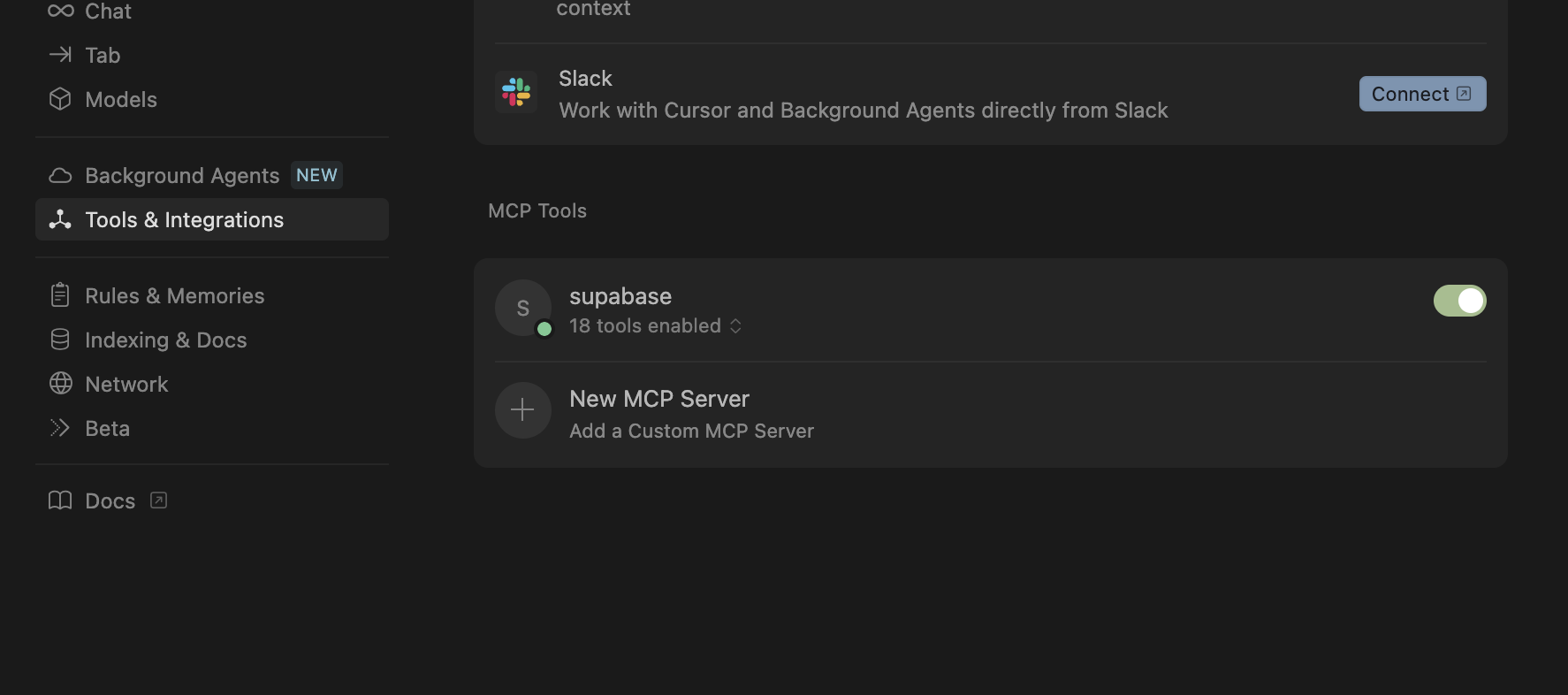
      Settings > Cursor Settings > Tools & Integrations > New MCP Server

    This opens a JSON editor where you’ll drop your database credentials.

    Where do you get MCP connection details?
    Depends on your database provider. Most modern DBs support MCP out of the box.
    If yours doesn’t, it’s ridiculously easy to spin one up locally. Ask Claude to build you a quick MCP server—it’ll even tell you how to run it.

    Once connected, you’ll see a green dot. Click the 'X tools enabled' to see what access the MCP has on your database.
    The one you must have is:
    execute_sql → lets Cursor run SQL queries directly.

    2. Ask Cursor to Map Your Database

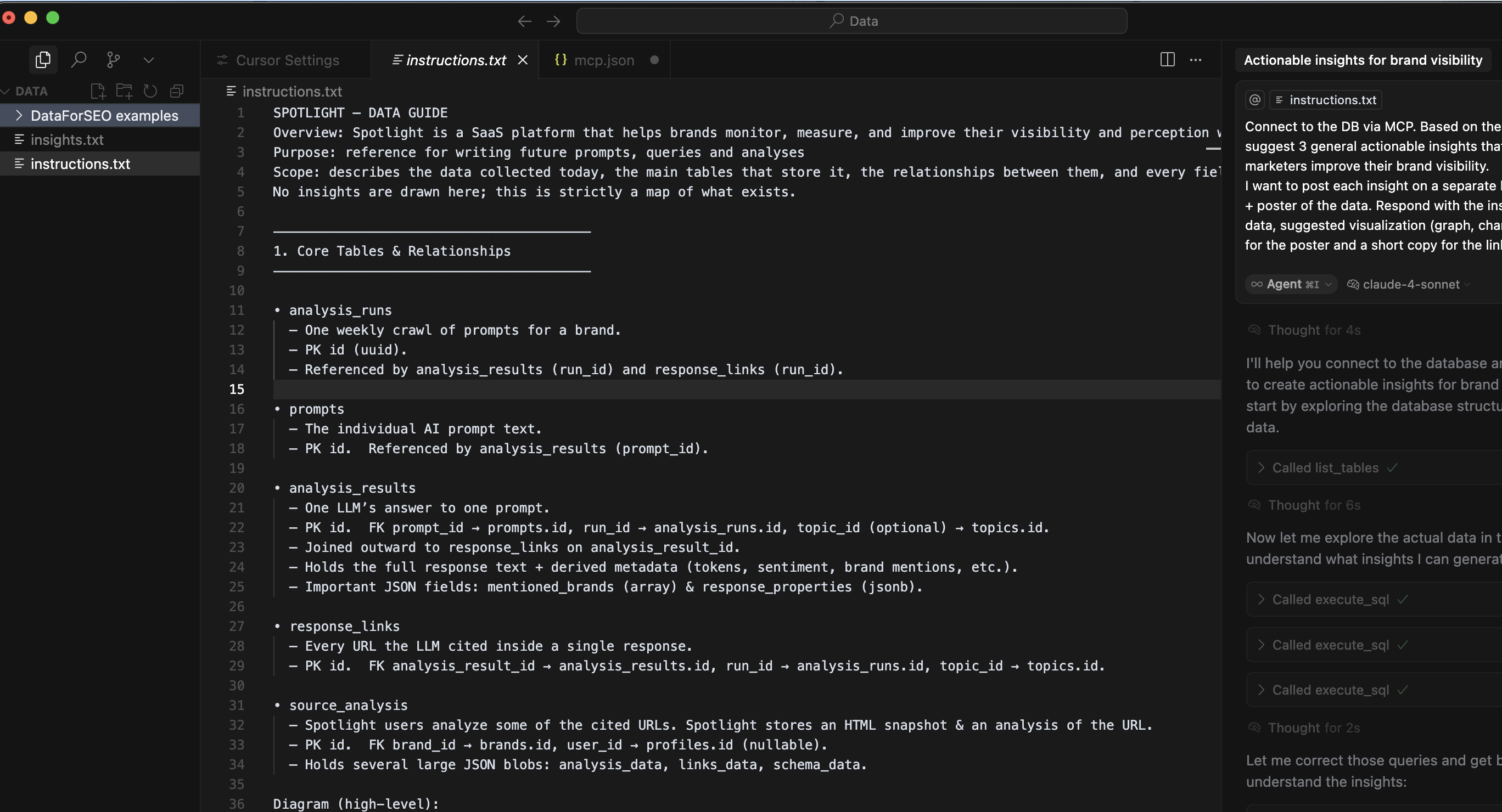
    Create a new text file (call it instructions.txt or whatever) and drop in this prompt.
    Use Agent Mode—preferably with Cursor 4 (but Gemini 2.5 or OpenAI o3 also work great).

    Connect to the DB using MCP. Study the table structure and relationships.  
    Write into the document a description of the tables along with data samples.  
    If a column is complex (JSON or arrays), fetch a few row samples and show examples of the values.  
    Write this description as a guide for future prompts to query the database for insights and actions. 
    Output the guide into @instructions.txt
    

    When it’s done, you’ll have a clean document describing your DB structure + sample data.


    3. Add Your Business Context

    Next, feed Cursor a description of your business and objectives (grab an existing doc, or have Gemini/Perplexity generate one).
    Paste it at the top of your instructions file using this prompt:

    Add to the top of the file a description of my business and objectives:  
    [paste business description + objectives]
    

    Boom. Now Cursor understands both your data and what you actually care about.

    4. Query the Database for Insights

    Time for the fun part.
    I used Claude 4 in Agent Mode, with the instructions file as context. Here’s the prompt (modify according to your needs):

    Connect to the DB via MCP.  
    Based on the instructions file, query and analyze data and extract 
    [10 generic actionable insights that could help marketers improve their brand visibility in AI chatbots].  
    
    For each insight, show me the underlying data + calculations used.  
    Write the results into a new file. 
    

    Where to Go From Here

    Now you’re basically unlimited:

    • Open new chats, just remember to attach your instructions.txt (or make it a global rule).

    • Always use Agent Mode (MCP won’t work otherwise).

    • Try different models:

      • Gemini 2.5 → giant context window.
      • OpenAI o3 → ridiculously sharp reasoning.
      • Claude → fast and reliable.

    Discover something cool?
    Hit me up → michael@get-spotlight.com

  • Built to Be First: The Cognitive Science Behind LLM Visibility

    Back in 2012, visibility was something you could buy.
A well-placed bid, a few clever keywords, and a handful of backlinks were enough to nudge your brand onto page one. Search was a game — noisy, yes, but knowable. You could outspend, out-optimize, or outwait the competition.

    That world is vanishing.

    In its place: a quieter, more opaque ecosystem where visibility is bestowed. Where your brand’s presence is no longer earned through page clicks, but summoned by the cold inference of a machine.Welcome to the age of the large language model.

    The Tyranny of Being First

    Ask ChatGPT a question about mortgages, or Claude about ESG investing, or Perplexity about crypto wallets and you’ll notice something. The same names surface. Again and again. Not because they’re the most ethical. Or the most innovative. But because they were early. Structured. Frequently cited. Built for machines, not just for humans.

    What’s at play here is not just technology. It’s psychology.

    Cognitive science calls it the primacy effect: our bias toward what we see first. What we see first, we remember. What we remember, we trust. In a world where LLMs are becoming the new front page of the internet, first position is not a convenience. It’s destiny.

    Add to that position bias; our tendency to believe top-ranked answers are more credible and you begin to understand: in LLMs, perception is reality.

    And for the brands that aren't in the first wave of answers? They might as well not exist.

    Your Brand, as Understood by a Machine

    LLMs don’t “search” the way humans do. They don’t care about page rank or ad spend. They absorb. They predict. They stitch together meaning from trillions of words. Which means they understand your brand not through your home page or your brand film but through your residue.

    Your brand is a statistical pattern. A mesh of citations, sentence structures, contextual cues. Not what you say, but how you’re spoken about. Not what you publish, but how the internet metabolises it.

    This changes the brief entirely.

    Too many marketers respond to LLM invisibility the wrong way. They panic, publish more, ramp up SEO production as if they’re shouting louder into a storm. But LLMs aren’t impressed by noise. They’re selective readers with very particular tastes: clarity, citation, semantic structure, regional grounding, and source reliability.

    Publishing more is irrelevant unless what you publish is aligned with how machines think.

    So pause. Audit. Not with SEO tools; but with an LLM lens. Where are you showing up? How are you being described? What types of content in your category are surfacing consistently and why?

    You need to forget what’s trending and look at what’s recurring.

    Get Your House in Order
    Before you aim to outrank your rivals, you need to clean up your own signal.

    Is your content geo-anchored?

    Is your language consistent across regions and channels?

    Are you cited by sources LLMs trust?

    Are your most important assets digestible by machines?

    It’s not about saturation. It’s about precision. The brands that show up are the ones who leave a trail built to be followed: structured, relevant, machine-readable.

    SEO was about optimising content for discoverability. LLM strategy is about engineering content for adoption.

    Think about the models themselves. They're retrained, updated, and fine-tuned continuously. A single PR piece picked up in a government report can shift your brand's prominence overnight. A misattribution or outdated FAQ can bury your relevance for months.

    If you're still treating content governance like a hygiene task, you're already behind. It's the plumbing. The wiring. The bones.

    Your teams must treat LLM visibility as a living, breathing channel. One that requires constant monitoring, real-time feedback loops, and proactive adaptation. It’s not a campaign. It’s a system.

    There is an unspoken danger here.

    LLMs aren’t echo chambers; they’re architects of what gets remembered. That means the brands that win visibility early get more exposure, more citations, more inferred credibility and, in turn, more inclusion in future model updates. It’s a feedback loop. One that doesn’t necessarily reward truth, quality, or innovation. It rewards presence.

    If your competitor is first, they get to define the category. Not just in language, but in logic.

    The most dangerous place for a brand to be is not misunderstood. It’s unmentioned.

    So What Next?

    Forget the homepage redesign. Forget the microsite. If you want to matter in the age of LLMs, you need to stop creating content for humans to browse and start creating content machines will choose.

    Because here’s the reality no one wants to say out loud: the content that shapes rankings in ChatGPT, Claude, Gemini, and Perplexity isn’t the loudest. It’s the most usable. The most structured. The most model-friendly. And that doesn’t happen by accident—it happens by design.

    The models are telling you what they like. You just have to listen. Look at the answers. Study the formats that keep surfacing. Track the patterns. Then build accordingly.

    And once you've done that? You don’t sit back. You watch.

    LLM visibility isn’t static, it moves. What appears in answers today might be gone by next week. A competitor publishes a better version. A new model rolls out. The model drifts. Suddenly, you’re out of the conversation.

    If you’re not tracking your content’s performance across models, you’ll lose ground before you even realise you were in the race. This is survival. You need a system. A tool. Something built to monitor the rise and fall of your visibility in real time. Because that’s the only way you stay ahead of the pack.

    This is the new frontline of digital relevance. No second pages. No fallback clicks. Just one shot to be part of the answer.

    If you’re not building for the model, you’re building for no one.

    Because in this new ecosystem, relevance isn’t granted by search engines or swayed by paid media. It’s determined by machines parsing trillions of signals—and deciding, in milliseconds, whether you matter.

    There’s no front page. No scroll. No second chance.

    You’re either chosen, or you’re not.

    Spotlight exists to make sure you are.

    It shows you what the models see. Tracks how your brand moves across answers. Flags the gaps. Surfaces the threats. And helps you create content the machines are more likely to use; again and again.

    In a world where LLMs are the new gatekeepers of visibility, Spotlight is your radar, your compass, and your competitive edge.

    Because if the models are shaping the future of your brand, you’d better be shaping what they learn.

    Sources
    www.get-spotlight.com

    Primacy Effect (https://wirkungswerk.de/en/primacy-effect-a-critical-consideration/)

    Position Bias (https://medium.com/manomano-tech/conquering-position-bias-d64880104fd4#)

  • The Biggest Shift in Brand Visibility Since the Internet — And No One’s Ready

    Late one evening, a friend told me how he’d asked ChatGPT about his child’s fever. The model responded with a shared citation: “According to Mayo Clinic…” It provided relief and it built trust. That moment, seemingly small, marks a profound departure in how we discover brands. We’ve moved past search; we are now existing in a world of conversation. Questions don’t go to Google; they go to generative models. The moment the model “remembers” a brand, that brand exists. And if it doesn’t recall you? You are invisible.

    It’s not merely anecdotal. A Stanford research team demonstrated that AI responses bearing clear citations earn significantly more trust—even when the answer is imperfect. Meanwhile, global surveys from KPMG and Gartner reveal a dissonance: while over 75% of professionals expect AI to reshape their work within two years, fewer than half say they trust its output. In an ecosystem where attention is concentrated in conversational windows, not search pages, that trust gap becomes a battlefield—and brands carry both the risk and the opportunity.

    To understand what’s unfolding, we can look back to when feature-phones morphed into smartphones. Brands that dominated the App Store climbed not through keywords, but by embedding themselves into the very platform interface. LLMs represent the same transformation. They aren’t indexing URLs—they’re weaving associations into their memory. And brands that fail to form part of that weave risk being bypassed altogether.

    This is where www.get-spotlight.com steps onto the stage. Without fanfare, it gives brands a pulse check on how frequently and in what tone they appear in model-generated answers. More than visibility, it tracks sentiment and data sources; a brand-level X-ray for AI recall. One B2B SaaS client discovered that after distributing structured content to neutral repositories and securing citations in high-authority sources, their brand recall in LLM responses jumped 42%. Competitors? Virtually unchanged.

    Deepfakes and automated misinformation grab headlines, but they matter only if users expect reliability. In generative conversations, reliability begins with citation. That’s why brands need a new form of storytelling: one that supplies the narrative, context, and authority models consume; and remember.

    Forget optimising for clicks. Forget chasing SERP rankings. Your strategic priority must shift toward quiet memorability: structured, sourced, model-readable context that lingers in the AI mind even between sessions.

    Because tomorrow, when someone asks, “Which CRM should I trust?”, the brand that’s not merely recalled; but memovoked, wins. And in the quiet between question and answer, brands either are or are not present. That’s today’s battleground.

    Sources

    Stanford HAI on AI citation trust
    https://hai.stanford.edu/news/generative-search-engines-beware-facade-trustworthiness

    Axios on citation-based trust in generative search
    https://www.axios.com/2023/05/03/chat-based-search-citations-accuracy-research

    KPMG Global AI Study (2025)
    https://kpmg.com/us/en/articles/2025/trust-attitudes-and-use-of-artificial-intelligence.html

    Gartner research on AI and customer trust
    https://www.cxtoday.com/conversational-ai/customers-reject-ai-for-customer-service-still-crave-a-human-touch

    Business Insider summary of KPMG AI trust report
    https://www.businessinsider.com/kpmg-trust-in-ai-study-2025-how-employees-use-ai-2025-4

    The Australian on AI distrust in Australia
    https://www.theaustralian.com.au/nation/australians-less-trusting-of-ai-than-most-countries/news-story/ca11793f341b7bd5d2682ef6e8959cde

  • ChatGPT Search Inspector: How We Peek Behind the AI Curtain

    Have you ever wondered how ChatGPT finds answers when you ask it a question? Does it just know everything, or does it actually search the web?

    Here at Spotlight, our research team is obsessed with figuring out how AI tools like ChatGPT talk about brands. To help us understand what's going on under the hood, we built a simple (but powerful!) Chrome extension called ChatGPT Search Inspector.

    It’s a tool we use every day—and now we’re making it available to everyone.


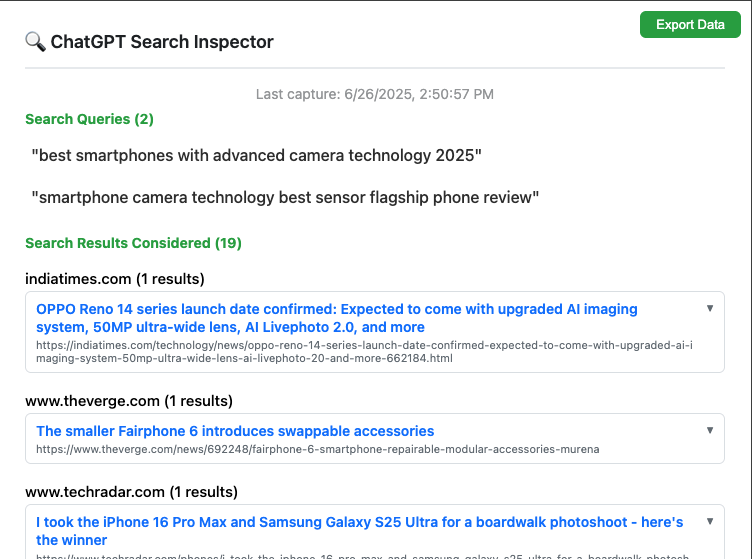
    ChatGPT Search Inspector extension screenshot

    Why Does ChatGPT Search the Web?

    First, let’s get one thing clear: ChatGPT doesn’t always search the internet. In fact, about 50% of the time, it gives answers from what it already knows from its training dataset.

    But when thinks it needs fresh data, it searches the web (Bing and/or Google) in real time.

    Here’s when ChatGPT might search the web:

    • To find up-to-date information (like current events, prices, or sports scores)
    • To discover product listings or comparisons
    • To check what’s trending or popular online
    • To look up specific websites or recent articles
    • When it needs more details it doesn't already know

    When it does this, ChatGPT sends a query to a search engine (usually Bing). Then, it looks through the top results, picks the ones that seem helpful, and uses them to build a response.


    What Does the ChatGPT Search Inspector Do?

    ChatGPT Search Inspector lets you see exactly what ChatGPT is searching and what links it’s reading. Think of it like holding a magnifying glass up to ChatGPT’s brain while it works.

    Here’s what the tool shows you:

    • Search queries ChatGPT sends to Bing
    • Web pages ChatGPT actually visits
    • Summaries of those pages (what info ChatGPT pulls out)
    • Timing of when each page was opened

    All this data appears in real time, while ChatGPT is browsing—right in your browser window.


    Why This Matters for Brands

    If you work in marketing, SEO, content, or brand strategy, this tool can give you superpowers. It shows which websites ChatGPT trusts, and what kind of content it uses in answers.

    That’s a huge deal. Why?

    Because when someone asks ChatGPT about your brand—or your competitor’s—it pulls from what it knows and what it finds. And what it finds depends on:

    • The search query it uses
    • The websites that show up in results
    • The content on those pages

    If your brand shows up often in those results? You’re in a good spot.
    If not? You might be invisible to AI.


    How Brands Can Use This

    By using ChatGPT Search Inspector, you can:

    • See what ChatGPT sees when it searches your space
    • Understand why your competitors show up more than you
    • Improve your content to match what ChatGPT prefers
    • Increase your chances of being mentioned or recommended

    FAQ

    Q: Who is this extension for?
    A: Anyone who wants to understand how ChatGPT uses the web—especially marketers, SEO pros, researchers, and content creators.

    Q: Do I need to know how to code?
    A: Nope! Just install the extension and open ChatGPT in your browser. It works automatically.

    Q: Does this work with all ChatGPT chats?
    A: After installed, it will automatically work when ChatGPT browses the web.

    Q: What data does it collect?
    A: The extension shows you what ChatGPT searches and reads—not your private messages or data.

    Q: Is it free?
    A: Yes! We made it for our internal research at Spotlight, but we’re sharing it publicly to help the community.

    Q: How do I install it?
    A: Go to the Chrome Web Store page and click “Add to Chrome.”


    A Bit About Spotlight

    We built this tool because we run Spotlight, a platform that helps brands understand how they show up in AI conversations.

    With Spotlight, you can:

    • Track your brand’s visibility across ChatGPT, Gemini, Claude, and Perplexity
    • Analyze what AI models say about you (and your competitors)
    • Discover which websites AI models rely on
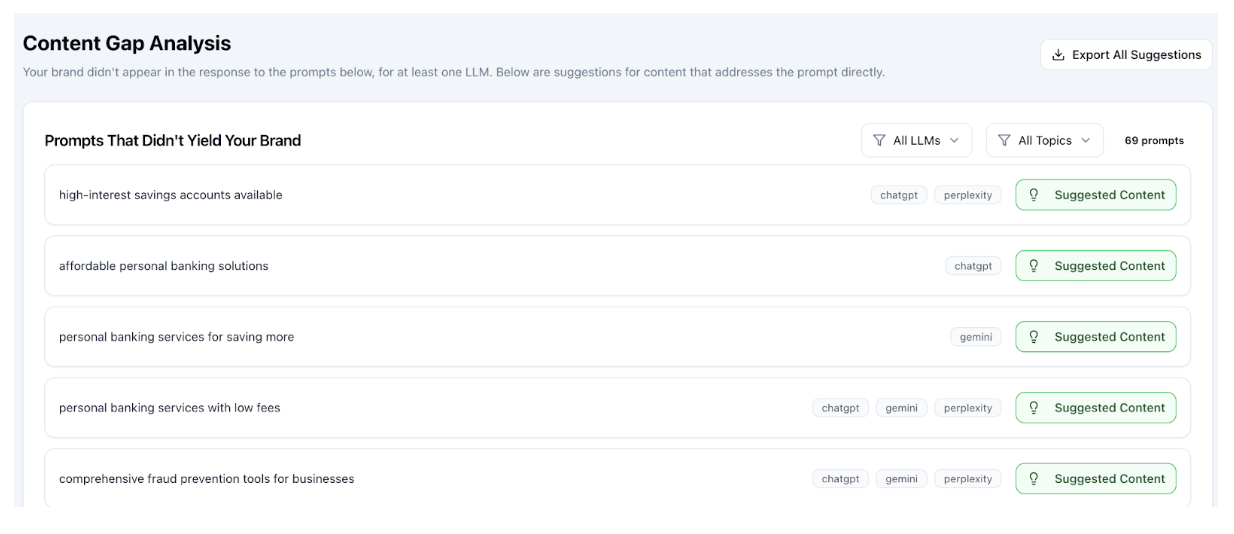
    • Get content suggestions to improve your presence
    • Optimize existing pages with smart tools

    And now, with ChatGPT Search Inspector, you can go even deeper—by seeing how ChatGPT thinks in the moment.


    Ready to Try It?

    The extension is available now. Use it to:

    • Watch ChatGPT’s live search activity
    • Discover what content influences answers
    • Learn how to get your brand seen (and trusted)

    Install ChatGPT Search Inspector on Chrome now


    Final Thoughts

    AI assistants like ChatGPT are becoming the new front door to the internet. What they say—and what they don’t—can make a big difference for your brand.

    ChatGPT Search Inspector is our way of opening that door a little wider. It’s free, easy to use, and gives you real insight into how modern AI thinks.

    Whether you’re a curious marketer, a tech-savvy founder, or just someone who wants to peek inside the AI brain—this tool is for you.

    Let us know what you find. We’re learning too.