Category: blog

  • From SEO to AEO: Winning in the New Age of Answer Engines

    For two decades, the goal of digital marketing was to win the click. Brands invested billions to climb Google’s rankings, guided by the principles of Search Engine Optimization (SEO). But that era is ending. A fundamental behavioral shift is underway, as users increasingly bypass traditional search for the direct, synthesized responses of Large Language Models (LLMs). For business leaders, this isn't a minor technical adjustment; it's a strategic inflection point. The new mandate is Answer Engine Optimization (AEO), and mastering it will define the next generation of market leaders.

    The Inevitable Shift from Search to Synthesis

    While Google’s dominance remains formidable, the tectonic plates of information discovery are moving. ChatGPT now handles billions of queries a week, and the growth is compounding. More critically, the nature of search is changing. Research from Bain & Company reveals a startling trend: 40% of consumer queries are now resolved without a single click, thanks to generative AI integrated into search results.

    This pattern echoes previous digital disruptions. E-commerce languished until innovations like one-click checkout removed friction. Mobile internet usage exploded only after app stores and affordable data plans created a seamless user experience. LLMs represent a similar tipping point for information. They deliver instant, polished answers, collapsing the discovery funnel and threatening to make brand websites a destination of last resort. For brands built on attracting traffic, this is an existential threat.

    The New Playbook: From Keywords to Credibility

    The tactics that defined SEO are insufficient for this new reality. The old model was a game of visibility; the new one is a game of authority.

    Traditional SEO is engineered to rank a page. It relies on keywords, backlinks, site speed, and technical structure to signal relevance to a search engine crawler. The primary goal is to entice a user to click through to a brand's owned digital property.

    Answer Engine Optimization (AEO) is engineered to become the source. It emphasizes structured, conversational knowledge that an LLM can easily parse, verify, and cite. The goal is not merely a click, but to be the definitive answer woven directly into the user’s response. Success is measured in mentions, citations, and influencing the AI's output—not just traffic.

    This transition from a page-centric to a knowledge-centric model requires a profound strategic shift. An LLM doesn't "visit" your homepage; it ingests your entire digital footprint—from your site's FAQs and product data to your mentions in trade publications and reviews on third-party sites—to form a holistic judgment of your authority.

    Evidence from the Front Lines

    This is not a future-state prediction; the correlation between authority and visibility is already quantifiable. One recent analysis found a 67–77% correlation between ranking on the first page of Google and being cited as a source by leading LLMs like ChatGPT and Perplexity. The authority signals Google has long valued are now the foundational training data for its successors.

    Furthermore, generative AI is rapidly becoming a commercial channel. Bain reports that 42% of Gen AI users now rely on it for shopping recommendations. As noted in the Financial Times, this has spurred a new category of marketing technology, with firms like Profound and Brandtech emerging to help brands track and improve their visibility within AI-generated results. They recognize that if you aren't the source of the answer, you are invisible.

    Four Strategies to Build Authority in the AEO Era

    Thriving in this ecosystem requires rewiring content strategy around four strategic pillars:

    Structure Content for Inquiry, Not Just Keywords.

    LLMs prioritize content that directly and authoritatively answers a question. Brands must move beyond keyword-stuffing and develop robust clusters of content—comprehensive FAQs, "how-to" guides, and glossaries—that are clearly organized with conversational headers and schema markup. The objective is to create modular, easily digestible knowledge blocks that an AI can confidently extract and present as fact.

    Build a Web of Trust Beyond Your Website.

    An LLM's confidence in your answer is determined by cross-domain validation. A brand's own website is just one data point. The new currency is distributed authority. This requires a renewed focus on public relations, industry partnerships, and earning citations in reputable news outlets, academic papers, and high-authority review sites. Your credibility is only as strong as your network of external validators.

    Align Content Architecture to the Full Spectrum of Consumer Questions.
    Instead of creating disconnected blog posts, leaders must architect themed content hubs that anticipate and address a wide range of related user intents. By building a comprehensive knowledge base around a core topic—from informational queries to purchase considerations—a brand signals to an LLM that it is a definitive authority in that domain.

    Measure What Matters: Mentions and Citation Velocity.
    The old dashboards of traffic and rankings are becoming obsolete. Leaders must adopt new tools to measure AEO performance, tracking how often their brand is cited in LLM outputs for key queries. This "share of answer" is the new "share of voice." Companies like Revere and Further are pioneering this space, offering analytics to help brands understand their visibility and influence within conversational AI.

    The Leadership Imperative

    The move from SEO to AEO is not a marketing task to be delegated; it is a strategic imperative for the C-suite. It challenges how businesses structure their content, measure their market presence, and define their digital authority.

    Leaders who continue to view their digital strategy solely through the lens of driving traffic to a website risk being disintermediated into oblivion. The brands that will thrive are those that pivot now, rebuilding their content philosophy not just for human readers, but for the machines that increasingly serve as our primary gateway to information. The future of brand discovery will not be about being found; it will be about being the answer.

  • LLMs vs Search: The Coming Battle for Consumer Attention

    LLMs vs Search: The Coming Battle for Consumer Attention

    There is a simple truth that drives human behaviour across centuries: when given the choice, people will always migrate toward actions that are quicker, easier, simpler, faster, and more effective.

    This behavioural law is agnostic of technology or culture. It is the reason we moved from hunting to agriculture, from horse-drawn carts to automobiles, from physical maps to GPS. Convenience compounds. Once a more frictionless path becomes visible, the migration is inevitable.

    Today, we are witnessing the early edge of such a shift in the digital space: the movement from traditional search engines to Large Language Models (LLMs) as the primary interface for information and decision-making.

    A Slow Uptake That Will Snowball 

    At present, the pace looks modest. Global consumer adoption of tools like ChatGPT, Claude, Gemini, and Perplexity still represents a fraction of total online queries compared to Google Search. It is easy to look at today’s data and conclude that search will remain dominant for years to come.

    But this thinking ignores a well-documented pattern from technology adoption history: these shifts start slow, then snowball—fast.

    We have seen it before. In the early 2000s, few believed that online retail would threaten physical stores. Early e-commerce was clunky and limited. But once Amazon’s one-click purchase model and same-day shipping reduced friction to near-zero, consumer behaviour tipped dramatically. The same happened with mobile-first content: until smartphones were ubiquitous and data plans cheap, desktop ruled. Then behaviour changed almost overnight.

    Why? Because once a new path offers a meaningfully easier and faster experience, the user migration is not linear, it is exponential. Each improvement in the underlying technology accelerates the curve.

    This is precisely where LLMs are today. The early friction—limited accuracy, slow response times, unfamiliar UX—is dissolving quickly. The ability to ask a question and receive a clear, synthesised answer—without sifting through links, clicking, or reading—maps perfectly to the human drive for simplicity and speed.

    The shift is deeper than convenience. LLMs do not just present information, they compress the decision journey. Instead of searching, comparing, and evaluating, users will increasingly rely on these models to suggest, rank, and even execute choices on their behalf. In marketing terms, the funnel is collapsing into a single conversational layer.

    Critically, this shift will not be confined to a niche of early adopters. Just as mobile content consumption leapt from tech enthusiasts to the mass market once the experience was seamless, the same dynamic will unfold here. Already, major players—Google, Apple, Microsoft—are embedding LLM interfaces into core products used by billions. As this happens, consumer interaction patterns will rewire rapidly.

    Refining Marketing Strategies to Include LLM Visibility 

    For brands, the implication is profound. The battleground is no longer just about ranking on a search results page. It is about being surfaced, recommended, and trusted in the model’s output at the exact moment of consumer intent. And this requires a different content strategy, data approach, and brand presence—optimized for the AI’s reasoning layer, not just the search index.

    This also implies SEO strategies now must include LLM SEO for a brand to be successful across all channels. If a brand isn’t mentioned in the LLMs it runs the risk of becoming invisible once the uptake in AI engines really takes off. Brands will also need to track their results, and that is where LLM SEO trackers such as Spotlight come in. 

    However, some will argue that because LLM traffic is still relatively small, there is time to react. History suggests otherwise. When the behavioral tipping point comes—and it will—it will move faster than expected.

    We are not witnessing a marginal shift. We are witnessing the beginning of a new primary interface for digital behaviour. The brands that understand this, and invest now to adapt their content and strategies for the LLM paradigm, will find themselves far ahead of the curve when the snowball begins to roll.

  • How Chatbots Are Quietly Becoming the World’s Biggest Salespeople

    The Big Idea

    A tectonic shift in digital commerce is underway. Until recently, AI assistants were tools for search and summarisation. Now, they are evolving into active agents capable of executing complex commercial transactions. Leading payment brands like PayPal , Klarna , and Shopify are embedding their services directly into platforms like ChatGPT, Perplexity, and Claude, collapsing the traditional customer journey from discovery to purchase into a single, seamless conversation.

    This move toward agentic commerce, where AI acts on a user's behalf to spend money, represents the most significant disruption to the digital storefront since the rise of mobile. For leaders, the question is no longer if they should integrate into these ecosystems, but how to do so in a way that builds brand equity and captures a new, high-intent market. Companies that fail to adapt risk becoming invisible to the next generation of consumers.

    The line between seeking information and making a purchase has officially blurred to the point of vanishing. Consider this near-future scenario: A marketing manager asks an AI assistant, “Find and book a flight to the Singapore conference next month, business class, and a hotel near the convention center with a gym. My budget is $6,000.” In the past, the AI would have returned a list of links, sending the user on a multi-tab journey through airline and hotel websites. Today, it can do much more. It can present three optimised packages, and upon the user’s command; “Book option two”; it can execute the purchase from Hilton and Singapore Airlines using a pre-linked PayPal or credit card account, all within the same conversational window.

    These integrations represent a fundamental rewiring of digital commerce. They move the point of sale from a destination website or app to the very point of consumer intent. For business leaders, this shift requires a new playbook. The strategies that defined success in the eras of web and mobile commerce; search engine optimisation, social media marketing, and app-store visibility; are insufficient for a world where the primary interface for commerce is a conversation.

    Why This Changes Everything
    The move to agentic commerce presents both a profound opportunity and an existential threat. Leaders who grasp the strategic implications can build deep competitive moats, while those who don’t will lose control over their customer relationships. Four key shifts demand immediate attention:

    1. The Funnel Collapses into a Conversation. The traditional marketing and sales funnel; awareness, consideration, conversion; is obsolete in an agentic model. An AI assistant can take a user from a vague need (“I need a gift for a new homeowner”) to a completed purchase in seconds. This compression means brands have only one chance to make an impression. The "shelf space" is no longer a search results page or a social feed; it's the AI's recommendation. The critical challenge shifts from driving traffic to ensuring your products and services are the ones the AI knows, trusts, and selects.

    2. A New, High-Intent Distribution Channel Emerges. AI platforms are a new category of distribution. Unlike traditional advertising, where brands push messages to passive audiences, agentic commerce is a pull model. Consumers are explicitly stating their needs and granting the AI permission to solve them. This is the highest-intent channel imaginable. Brands that are integrated are positioned to capture sales at the peak moment of consumer desire, while those outside the ecosystem are simply not part of the consideration set.

    3. Trust Becomes a Transferable Asset. A significant barrier to conversion in traditional e-commerce is checkout friction and payment security concerns. By embedding trusted brands like PayPal, Visa, and Mastercard directly into the chat, AI platforms are borrowing decades of established consumer trust. This dramatically lowers the perceived risk for users, increasing conversion rates and reducing cart abandonment. For brands, this means the technical and psychological burden of building a trustworthy checkout experience is handled by the platform, freeing them to focus on product and service quality.

    4. Data and Personalisation Reach a New Frontier. The data generated from conversational transactions is richer than any clickstream data that came before it. Brands can gain unprecedented insight into the context of a purchase: the questions the user asked, the alternatives they considered, and the specific priorities they voiced (e.g., sustainability, speed of delivery, budget). This allows for a new level of personalization in product development, loyalty programs, and follow-on marketing that is predictive rather than just reactive (This is exactly what Get Spotlight is doing)

    The Strategic Imperative: A Playbook for the Agentic Era
    Navigating this new landscape demands a strategic realignment. Leaders should focus on three priorities:

    First, rethink the customer journey around conversational discovery. Your digital presence must be optimised not just for human crawlers but for AI agents. This means structuring product data, descriptions, and inventory levels so they are easily digestible and verifiable by AI models. It involves creating rich, descriptive content that answers the kinds of complex, multi-layered questions users will ask. Ask your team: If an AI were our primary sales associate, would it have the information it needs to recommend our product confidently?

    Second, build for interoperability and forge the right partnerships. In the agentic era, your business will exist as a node in a larger network of services. Success depends on how easily your systems can connect with others. This means prioritising API-first development and actively seeking integrations not only with AI platforms but also with the payment, logistics, and customer service providers that are part of their ecosystems. Your competitive advantage will be defined by the strength and seamlessness of your connections.

    Finally, realign marketing and sales to influence the AI. The new gatekeepers are the algorithms that power these AI assistants. Your marketing efforts must now be geared toward "recommender-engine optimisation." This could involve creating highly detailed product guides, generating positive and verifiable customer reviews, and ensuring your brand is prominently and positively featured in the data sets on which these models are trained. The goal is to become the AI’s trusted and default choice in your category.

    The era of passive, destination-based e-commerce will decline. The new frontier is conversational, agentic, and happening in the interfaces where consumers are already spending their time. By embedding payments, AI platforms have removed the final point of friction, transforming chat from a tool for inquiry into an engine for commerce. For leaders, the message is clear: the storefront is no longer a place you build, but a conversation you join. Those who learn to speak the language will thrive. Those who don’t will be met with silence.

  • The Wild West Is Back: Why 2025 Feels Like 2003 All Over Again

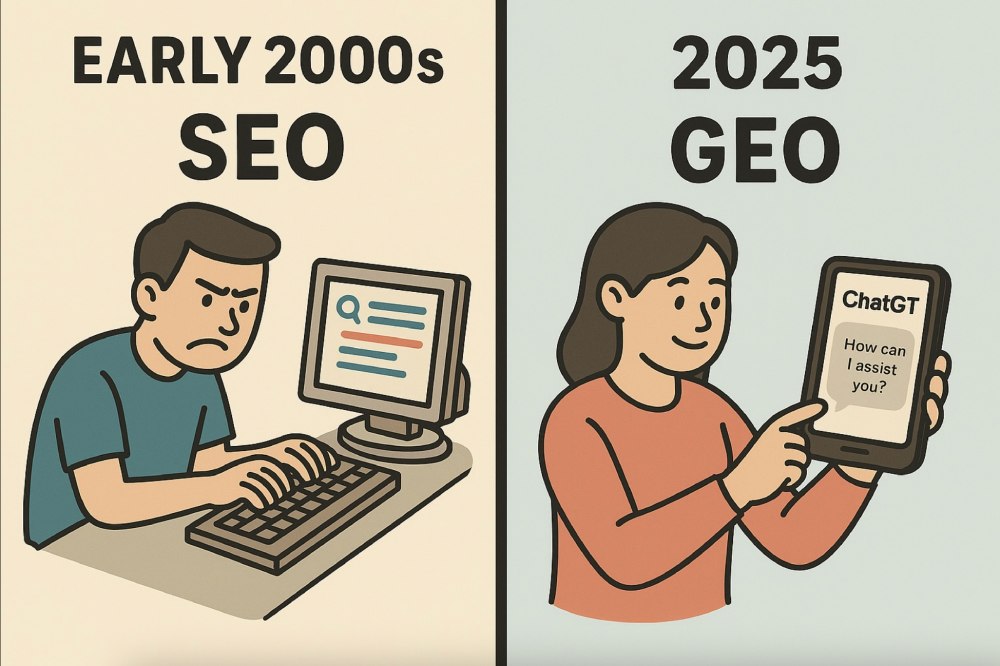
    SEO vs GEO

    Remember 2003? George W. Bush was president, everyone had flip phones, and Google was this scrappy search engine that most people still called "that Stanford thing." But if you were running a website back then, you probably remember something else: the absolute chaos of early SEO.


    The 2003 SEO Gold Rush: When Nobody Knew the Rules

    Picture this: You're a small business owner in 2003. Your competitor just hired some "SEO expert" who promised them page one rankings for $500 a month. Suddenly, when people search for "best pizza Chicago," your competitor shows up first and you're nowhere to be found.

    The Wild West Rules of Early SEO

    Back then, SEO was pure Wild West. Nobody had a playbook because there was no playbook to have:

    • Keywords were everything – Stuff "best pizza Chicago" into your page 47 times and watch the magic happen
    • Backlinks were currency – Get 1,000 random websites to link to you (quality didn't matter)
    • Algorithm updates meant chaos – Winners became losers overnight
    • Small fish could eat big fish – A smart college kid could outrank Fortune 500 companies

    The early adopters? They absolutely crushed it. Companies that figured out SEO in 2003-2005 built empires while their competitors were still buying Yellow Pages ads.


    Welcome to 2025: The GEO Gold Rush

    Fast forward to today. ChatGPT has 100+ million weekly users. Perplexity is handling millions of searches daily. Gemini is integrated into every Google service you use.

    And for the first time since 2003, we're in another "figure it out as you go" moment.

    The Uncanny Parallels Between SEO 2003 and GEO 2025

    Except this time, it's not about ranking #1 on Google. It's about being the answer that AI gives to millions of users when they ask questions about your industry.

    Content Signals Are the New Keywords

    Instead of stuffing "best pizza Chicago" 47 times, you're optimizing for how AI models interpret, understand, and cite your content.

    Authority Is the New Backlinks

    AI models don't count links—they evaluate expertise, accuracy, and trustworthiness. But just like backlinks in 2003, most companies have no clue how to build this new kind of digital authority.

    Nobody Knows What They're Doing

    There's no "GEO for Dummies" book yet. Most marketing teams are still debating whether they should care about AI search.

    Small Businesses Can Compete Again

    A startup with great content and smart positioning can show up in AI responses alongside IBM and McKinsey.


    Why This Moment Actually Matters More Than 2003

    Here's where 2025 gets really interesting: The stakes are higher now.

    The Compounding Effect of AI Training

    In 2003, if you missed the SEO boat, you could catch up in a few years. But AI search is different. These models are training on content right now. The patterns they learn today will influence their recommendations for years to come.

    Think about it: When someone asks ChatGPT "What's the best CRM for small businesses?" or "Who are the leading cybersecurity companies?", what answer do they get?

    If your company isn't part of that conversation now, when will you be?


    The Patterns That Never Change

    Here's what's wild: The fundamental dynamics haven't changed since 2003.

    First Movers Win Disproportionately

    The companies that figured out SEO early didn't just get traffic—they defined entire categories. When you searched for "project management software" in 2005, certain companies owned that conversation for years.

    Complexity Creates Opportunity

    Most companies are paralyzed by AI search because it seems overwhelming. But complexity is exactly where nimble companies beat bureaucratic ones.

    The Right Tools Create Unfair Advantages

    Just like early SEO spawned companies like Moz and SEMrush, GEO is creating new intelligence platforms. The companies using these tools have massive visibility advantages.

    Good Enough Beats Perfect

    In 2003, a "good enough" website that was properly optimized demolished a beautiful website that wasn't. Today, consistently good content that's optimized for AI discovery beats perfectly crafted content that AI models never encounter.


    What Smart Companies Are Doing Right Now

    The playbook is surprisingly similar to 2003, just updated for the AI era:

    1. Audit Your AI Visibility First

    Most companies have zero idea how often they appear in AI responses or in what context. It's like running a website in 2003 without checking your Google rankings—marketing malpractice.

    2. Hunt for Content Gaps Relentlessly

    What questions is your audience asking that AI models aren't getting authoritative answers for? That's your opportunity. That's your "underpriced keyword" moment.

    3. Build Authority Systematically

    Create comprehensive, well-researched content that AI models can confidently cite. Think Wikipedia-level reliability meets industry expertise, not generic blog posts.

    4. Monitor Competitors Obsessively

    See exactly where competitors are showing up in AI responses and where they're not. Then systematically fill those gaps before they do.

    5. Experiment and Measure Constantly

    Try different content formats, topics, and approaches. Track what works. Double down ruthlessly on what succeeds.


    The Next 18 Months Will Define the Next 10 Years

    Here's my prediction: By the end of 2026, we'll look back at 2025 the same way we look back at 2003-2004 for SEO.

    Clear Winners vs. Clear Losers

    • Winners: Companies that moved fast and built sustainable advantages
    • Losers: Companies that waited and are now asking "How did we miss this?"

    The Key Difference from 2003

    We actually have the data and tools to see what's happening in real-time. Platforms like Spotlight can show you exactly how AI models perceive your brand, where you're appearing in responses, and where your competitors are beating you.


    The Choice Is Yours: Early or Late?

    The question isn't whether GEO matters—we're past that debate. The question is whether you'll be early or late to the party.

    And if you remember how the 2003 SEO story ended, you know why timing matters.

    The companies that moved fast built empires. The companies that waited became footnotes.

    Which story will you write?


    Ready to see how AI models currently perceive your brand? Get a free visibility report and discover where you stand in the new search landscape—before your competitors figure it out.

  • The Agent Economy Is Here: Why AI Brand Perception Will Determine Your Market Position

    Buy directly on AI Chatbots

    The purchasing landscape is undergoing its most fundamental shift since the rise of e-commerce. Within the next five years, autonomous AI agents will handle a significant portion of consumer and B2B buying decisions—from routine purchases to complex vendor selections. When that happens, traditional marketing playbooks become obsolete overnight.

    The data is already pointing toward this reality. Recent studies show that 73% of consumers already rely on AI-powered recommendations for product research, while enterprise procurement teams report using AI assistants for 41% of their vendor evaluation processes. These numbers aren't plateauing—they're accelerating.

    For brands, this shift presents a critical question: When AI agents become the gatekeepers of purchasing decisions, will your brand be recommended, ignored, or actively avoided?

    The Mechanics of AI-Driven Commerce

    To understand why AI brand perception matters, we need to examine how AI agents actually make purchasing recommendations.

    Unlike traditional search engines that surface links for human evaluation, AI agents process vast amounts of information and deliver definitive answers. When a consumer asks their AI assistant to "find the best project management software for a 50-person team," the agent doesn't provide a list of options—it recommends specific solutions based on its training data, real-time research capabilities, and learned preferences.

    The mechanism is straightforward but profound: AI agents synthesize information from millions of data points—product reviews, technical specifications, pricing data, company reputation signals, and content quality indicators—to form brand perceptions that directly influence recommendations.

    This creates a new reality where brand visibility isn't about ranking #1 on Google—it's about ensuring AI models have access to accurate, comprehensive, and favorable information about your brand across all the data sources they reference.

    Why Traditional Marketing Strategies Fall Short

    Most brands still operate under the assumption that direct customer touchpoints drive purchasing decisions. They invest heavily in paid advertising, SEO optimization, and direct sales outreach—strategies designed for human decision-makers who actively research and compare options.

    But AI agents don't click ads. They don't scroll through search results. They don't attend your webinars or download your whitepapers. Instead, they form impressions of your brand based on the aggregate information available across the internet, industry databases, and their training datasets.

    Consider this scenario: A procurement AI agent tasked with finding cybersecurity solutions processes information about your company from dozens of sources simultaneously—customer reviews on G2, technical documentation, pricing transparency, thought leadership content, social proof signals, and competitive positioning data. The agent's recommendation depends entirely on how these data points collectively represent your brand's value proposition.

    Traditional marketing metrics become secondary. High ad spend doesn't guarantee AI recommendations. Strong SEO rankings matter less than content quality and information accuracy. Even sales team relationships lose influence when AI agents handle initial vendor screening.

    The Competitive Advantage of Early AI Positioning

    The brands that will dominate the agent economy are those positioning themselves strategically in AI-accessible information ecosystems today—before their competitors recognize the opportunity.

    This advantage compounds over time. Early positioning in AI training data creates lasting impressions that become increasingly difficult for competitors to overcome. When AI models learn that your brand consistently appears in high-quality contexts alongside positive outcome indicators, that association influences future recommendations across countless purchasing scenarios.

    Smart brands are already taking action:

    • SaaS companies are optimizing their technical documentation and API references to ensure AI agents understand their capabilities accurately
    • B2B service providers are creating comprehensive case study databases that demonstrate measurable client outcomes
    • E-commerce brands are investing in structured product data and authentic review cultivation across multiple platforms
    • Professional services firms are publishing thought leadership that establishes expertise in AI-accessible formats

    The window for first-mover advantage is closing rapidly. As more brands recognize the importance of AI perception, the competition for favorable positioning intensifies. Early movers establish credibility and context that become self-reinforcing over time.

    Strategic Actions for Agent Economy Preparation

    1. Audit Your AI Visibility Profile

    Start by understanding how AI engines currently perceive your brand. Test your positioning across major AI platforms by asking specific questions about your industry, use cases, and competitive landscape. Document where your brand appears in responses and how it's characterized.

    Key evaluation areas:

    • Brand mentions in industry-specific queries
    • Competitive positioning accuracy
    • Feature and capability representations
    • Pricing and value proposition clarity
    • Customer outcome associations

    2. Optimize Information Architecture

    AI agents excel at processing structured, comprehensive information. Review your digital presence to ensure critical brand information is organized, accessible, and consistently presented across platforms.

    Priority optimization areas:

    • Technical specifications and feature documentation
    • Customer success stories with quantifiable outcomes
    • Pricing transparency and value justification
    • Integration capabilities and technical requirements
    • Competitive differentiation and positioning statements

    3. Establish Authority in AI-Accessible Formats

    Traditional content marketing focused on driving website traffic and generating leads. AI-era content strategy prioritizes information quality, accuracy, and discoverability by AI systems.

    Effective content approaches:

    • Detailed case studies with specific metrics and outcomes
    • Technical documentation that demonstrates product capabilities
    • Industry analysis that establishes thought leadership
    • Structured FAQ content addressing common buyer questions
    • Comparison frameworks that highlight competitive advantages

    4. Monitor and Influence AI Recommendations

    Active monitoring of AI-generated content about your brand becomes essential for maintaining competitive positioning. Establish regular assessment processes to track how your brand appears in AI responses and identify opportunities for improvement.

    Monitoring priorities:

    • Brand mention frequency and context
    • Competitive positioning accuracy
    • Feature and capability descriptions
    • Customer outcome associations
    • Pricing and value proposition representation

    5. Build Authentic Digital Authority

    AI systems prioritize credible, authoritative sources when forming brand impressions. Focus on building genuine expertise and reputation signals that AI agents recognize as trustworthy.

    Authority building tactics:

    • Contribute to industry publications and thought leadership platforms
    • Participate in professional communities and expert networks
    • Publish original research and data-driven insights
    • Establish partnerships with recognized industry leaders
    • Maintain consistent, high-quality content publication schedules

    The Strategic Investment Imperative

    This isn't optional preparation—it's competitive survival. The brands that invest in AI perception today will enjoy sustained advantages as AI agents become primary purchasing influencers. Those that delay will find themselves excluded from consideration before human decision-makers ever evaluate their options.

    The investment required is significant but manageable for most organizations: dedicated resources for content optimization, monitoring systems for AI visibility tracking, and strategic planning for long-term positioning. The cost of inaction—invisible to AI agents that drive future purchasing decisions—is exponentially higher.

    Forward-thinking brands recognize this moment as their primary strategic opportunity. While competitors focus on traditional marketing channels, early movers are establishing the foundation for dominance in an AI-driven marketplace.

    Spotlight: Leading the Visibility Revolution

    Understanding AI perception is just the beginning—actively shaping it requires the right intelligence and tools. Spotlight provides a visibility and research platform that modern brands need to monitor, analyze, and influence how they appear across generative AI engines.

    With capabilities spanning AI visibility dashboards, competitor positioning analysis, and content gap identification, Spotlight helps marketing teams move from reactive hoping to proactive positioning in the agent economy.

    The question isn't whether AI agents will influence purchasing decisions—it's whether your brand will be positioned to benefit from that influence. Generative search is rewriting the internet. Spotlight helps you lead the conversation.

    Ready to understand how AI engines currently see your brand? Get your free visibility report at get-spotlight.com and discover where you stand in the agent economy.

  • AI Blind Spots: Why Startups Get Left Out of AI Answers — and What You Can Do About It

    AI Blind Spots

    When someone asks ChatGPT, Perplexity, or Gemini:

    “What’s the best CRM for early-stage startups?”

    Chances are they won’t hear about your company — even if your product is exactly what that user needs.

    This isn’t a failure of your marketing team. It’s a structural reality of how modern generative engines operate, and the implications are massive.

    As generative answers replace search results, visibility in AI engines is becoming a growth channel — and startups are at a natural disadvantage.

    Let’s unpack why that happens and what you can do to fix it.

    How AI Engines Actually Generate Answers


    Most generative search tools today operate in one of three ways:

    1. Static LLM answers (e.g., ChatGPT-4 without Browse):
      Responses are based solely on the model’s internal training data, which is often several months old and skewed toward popular, well-cited content.
    2. LLMs with real-time retrieval (e.g., Perplexity, Gemini, ChatGPT with Browse):
      These engines pull current content from the web and combine it with the model’s reasoning capabilities to construct answers.
    3. Hybrid models with source citations:
      These are increasingly common and provide direct links to the sources that shaped the answer — allowing users to verify claims.

    In all of these cases, whether the answer is drawn from static training data or real-time web search, the systems are only as good as the sources they can access and trust.

    Why Startups Get Left Out


    Even with real-time search, generative engines prioritize:

    • Sites they index frequently
    • Sources with structured, well-linked content
    • Brands with semantic proximity to relevant queries

    Most startups fail to show up because:

    • Their brand is rarely mentioned outside their own site
    • They’re not linked to in comparative or informative articles
    • They haven’t built the contextual relevance engines look for when assembling answers

    This creates a visibility gap — not because your startup lacks merit, but because AI systems simply don’t have the evidence they need to surface you with confidence.

    It’s Not a Visibility Problem. It’s a Context Problem.


    Generative engines don’t make editorial decisions. They work probabilistically. When asked for something like:

    “What are the best AI tools for customer support?”

    They surface names that:

    • Are mentioned in multiple high-authority sources
    • Are semantically linked to that category
    • Match the structure and intent of the query

    Startups that don’t show up in that retrieval process don’t make it into the answer.

    They aren’t ignored — they’re invisible.

    What You Can Actually Do About It


    Let’s skip the slogans. Here’s what moves the needle.

    1. Diagnose the Current State

    Ask real prompts:

    • “What are the best lightweight CRMs for startups?”
    • “Alternatives to HubSpot for solo founders?”
    • “What AI tools help early-stage teams close more deals?”

    Document:

    • Which companies are named
    • What sources are being cited
    • Which phrases or attributes those companies are tied to

    Or, use Spotlight to do this at scale — across hundreds of prompts and domains — so you can stop guessing and see exactly how your category is represented in generative engines.

    Spotlight isn’t just a visibility tracker. It’s a research engine. It reveals the sources, formats, and content patterns influencing AI-generated answers in your category — and shows you what to create to wedge your way in.

    2. Seed the Right Signals — in the Right Places

    Publishing on your own site isn’t enough. You need:

    • Content on third-party domains that generative engines trust (like G2, StackShare, Reddit, and high-authority blogs)
    • Comparative content that ties your brand to search-intent keywords (“best tools for…”, “alternatives to…”, “founder-friendly CRMs”)
    • Semantic bridges: Mentions of your product next to well-known competitors or in shared use-case contexts

    Think in terms of retrievability: will this content show up when an engine scrapes the web to answer a question?

    Tip: Generative engines love structured data — lists, tables, FAQs. Shape your content accordingly.

    3. Track and Iterate Like It’s SEO — But Faster

    This isn’t a one-time fix. Generative visibility is dynamic. What works today may not show up tomorrow.

    Use Spotlight to:

    • Track how often you appear in AI answers
    • See what’s driving mentions (and what’s not)
    • Monitor your competitors’ visibility over time

    Treat this like GEO: Generative Engine Optimization.
    It’s not traditional SEO — but the strategic logic is similar. And the window for early visibility is closing.

    The GEO Window Is Now


    We’re at the very beginning of the generative engine optimization race.
    Right now:

    • Most companies don’t know this game exists
    • The cost of getting in is low
    • There’s still time to shape how your category is defined in AI

    In 12 months, your competitors will be spending serious budget trying to rank in generative engines.

    The content will be more competitive.
    The link graphs more entrenched.
    The answers harder to influence.

    If you’re a startup, now is the moment to establish your AI presence — before the drawbridge lifts.

  • Google’s AI Overviews Cut Clicks by 34.5%

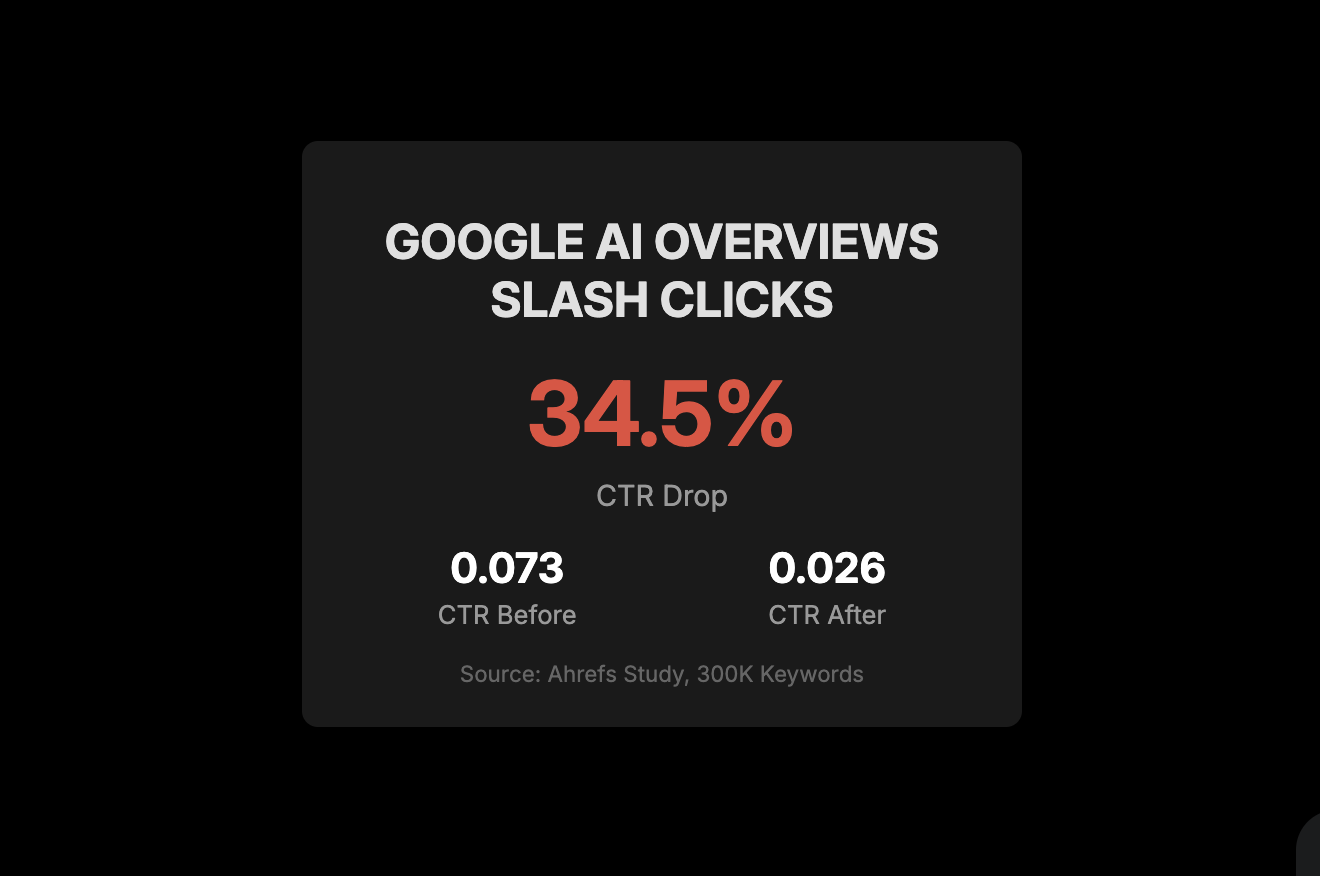
    New research from Ahrefs reveals that Google's AI Overviews significantly reduce clicks to websites. Their analysis of 300,000 keywords found that the presence of an AI Overview correlated with a 34.5% lower average clickthrough rate (CTR) for top-ranking pages.

    Google's AI overviews drops click rate by 34.5%

    The study compared clickthrough rates before and after the US rollout of AI Overviews:

    • For position one rankings with AI Overviews, CTR dropped from 0.073 in March 2024 to 0.026 in March 2025
    • For regular informational keywords, CTR fell from 0.056 to 0.031 in the same period

    This data directly contradicts Google CEO Sundar Pichai's claim that content within AI Overviews gets "higher clickthrough rates."

    Ahrefs' Director of Content Marketing, Ryan Law, notes this isn't surprising as AI Overviews function similarly to Featured Snippets by resolving queries directly in search results. He suggests clicks may reduce further as "the novelty wears off."

    Notably, Google still doesn't provide a way to see AI Overview performance separately in Search Console analytics.

    Source: Ahrefs: AI Overviews Reduce Clicks by 34.5%

  • Using AI? You need this Chrome Extension

    Let’s skip the foreplay.
    You’re buried.

    Beneath headlines, Slack threads, Zoom links, briefs that read like riddles, and deadlines that sprint faster than you do.

    Meanwhile, while you're keeping the lights on,
    AI is rewriting the rules.
    And it’s not asking your permission.

    By 2030, the LLM market alone is projected to balloon from $13.2 billion today to $49.9 billion.
    That’s a tectonic shift; and it’s already rumbling under your feet.

    Prompt Blaster puts you ahead of it.

    It’s a Chrome extension, sure.
    But it's also a truth serum, a spyglass, and a Molotov cocktail — depending on how brave you are.

    Prompt Blaster

    So, what’s it do?

    You write one prompt: just one.
    Prompt Blaster takes that single spark and fires it into every major LLM: GPT-4, Claude, Gemini, and the rest of the big dogs.
    Then it pulls their answers back: side-by-side, in real-time.

    No tab-hopping.
    No guesswork.
    No wondering if you’re winning or if your competitor is quietly eating your lunch.

    You see it all.

    You see how the machines — those trusted, tireless, whisper-in-the-ear machines — describe your brand.
    Or worse… how they describe your competitor.

    Why should you care?

    Because these models are no longer novelties.
    They are the front doors.
    The search engines.
    The gospel truth for your customers, your clients, and everyone in between.

    Already, OpenAI’s ChatGPT commands nearly 60% of the U.S. market.
    Microsoft Copilot? Another 14% — both powered by OpenAI.
    And fast-risers like Claude and Perplexity are seeing 10–14% quarterly growth, faster than anyone else.

    The battleground isn't coming.
    It's here.

    If GPT says your competitor is “a category-defining pioneer” and you’re “a company based in the UK,”
    congratulations; you just got flattened without even stepping into the ring.

    Here’s what Prompt Blaster lets you do:

    Stress test your messaging.
    Straplines. CTAs. Product blurbs.
    See what sings. See what stinks.
    Across every major model. In seconds.

    Spy on your competition.
    Run a prompt. Line up the answers.
    Watch who’s owning the narrative — and who’s bleeding out.

    Mine insights at the speed of thought.
    Brand audits, sentiment checks, press release dissections.
    Forget focus groups. Forget $20k research decks.
    The machines already know.

    Build custom prompt packs.
    Stop your team from reinventing the wheel.
    Start handing them race cars.

    Understand how the world sees you.
    Because today, it’s not your copywriter setting the tone.
    It’s the LLMs.

    No fluff. No fanboying over AI. Just raw leverage.

    Prompt Blaster doesn’t care if you're a CMO with a corner office or a junior planner living off bad coffee and big dreams.
    It gives you the same unfair advantage: clarity.

    And here’s the most important piece:
    Most brands aren’t watching what the models are saying yet.
    They’re sleeping on it.
    Which means if you move now, you’re early.

    By 2027? Being early won't be an option. It’ll just be the cost of staying alive.

    👉 Download the Prompt Blaster chrome plug-in
    Then fire off your first prompt and find out if you're the hunter or the hunted.

    If it doesn't shake something loose inside you, hell, maybe you deserve to be disrupted.

    But if it does?
    Congratulations.
    You just found your edge.

    Oh, and one more thing… did we mention it's free?
    For now.

  • AI Chatbot Market Share: April 2025

    Conversational AI Market Overview (April 2025)

    As of April 2025, the conversational AI market continues its remarkable growth. Recent analysis reveals OpenAI's ChatGPT maintains a dominant position, but emerging competitors like Perplexity and Claude show significant growth, hinting at potential market shifts.


    Current Market Share Distribution (April 2025)

    The following table details the estimated U.S. market share distribution for leading generative AI chatbots based on user numbers as of April 2025. Note that Microsoft Copilot, while listed separately, utilizes OpenAI's technology. [²]

    AI Chatbot Market Share Quarterly Growth Core Technology
    ChatGPT (OpenAI) 59.70% 8% ▲ GPT-3.5, GPT-4
    Microsoft Copilot 14.40% 6% ▲ GPT-4 (via OpenAI)
    Google Gemini 13.50% 5% ▲ Gemini Models
    Perplexity 6.20% 10% ▲ Mistral 7B, Llama 2
    Claude (Anthropic) 3.20% 14% ▲ Claude 3
    Grok (xAI) 0.80% 12% ▲ Grok 2, Grok 3
    Deepseek 0.70% 10% ▲ Proprietary
    Komo 0.60% 7% ▲ Proprietary
    Brave Leo AI 0.30% 6% ▲ Llama 2, Mixtral
    Andi 0.20% 4% ▲ Proprietary

    Market shares are based on U.S. user estimates. "AI Overviews" (associated with Google search) is not tracked separately and may be part of Google Gemini's data.
    Data source: First Page Sage [²]


    Market Share Trends (Jan 2024 – Mar 2025)

    Examining market share evolution over the past 15 months provides insights into competitive dynamics:

    • ChatGPT: Declined from 76.4% (Jan 2024) to 73.6% (Oct 2024), then stabilized around 74.1% by March 2025 (excluding Copilot).
    • Google Gemini: Fell from 16.2% (Jan 2024) to 13.3% (July 2024), with slight recovery to 13.7% (Mar 2025).
    • Perplexity: Doubled its share from 2.7% (Jan 2024) to 6.1% (Mar 2025).
    • Claude AI: Grew from 2.1% (Jan 2024) to 3.3% (Mar 2025).

    User Base and Growth Statistics

    While market share shows relative positioning, user numbers provide scale:

    • Google Gemini:
      ~67.29 million unique visitors (early 2025), supporting 46+ languages across 239+ countries. [³]

    • Claude AI:
      ~18.9 million monthly active users globally. Grew 300% from Dec 2023 to Dec 2024 (18.3M users), then adjusted to 16M in Jan 2025. Largest markets: U.S. and India. [⁴]

    • Perplexity:
      Surpassed 10M monthly active users by late 2023. Quadrupled adoption between Q2 2023 and Q1 2024. 38% of users are U.S.-based. [⁵]


    Market Growth and Projections

    • Conversational AI Market:
      Expected to grow from $13.2B (2024) to $49.9B (2030) — CAGR of 24.9%.
      Growth drivers: generative AI advances, integration with voice/vision, and preference for messaging-based customer service. [¹]

    • AI-Powered Search Segment:
      Valued at $3.2B (2023) → Forecasted $14.7B (2030) — CAGR of 24.5%.
      Broader AI search market may hit $50.3B by 2035. VC funding in AI search startups rose 147% in 2023. [⁵]


    Competitive Dynamics and Future Outlook

    While OpenAI technology (ChatGPT + Copilot) dominates with nearly 74% combined share [²], rapid growth from:

    • Claude: 14% quarterly growth
    • Grok: 12% quarterly growth
    • Perplexity: 10% quarterly growth

    …suggests a fragmenting and increasingly competitive market.

    Specialization Trends:

    • Perplexity: Accuracy-first, powered by Mistral 7B, Llama 2
    • Claude: Business-focused, using Claude 3

    Funding & Revenue:

    • Perplexity raised $73.6M, valuation $520M+ [⁵]
    • Claude AI reports $850M annualized revenue [⁴]

    As the market matures, key success factors will include accuracy, functionality specialization, and integration capabilities.


    Sources

    1. MarketsandMarkets – Conversational AI Market Research Report (Market Size & CAGR)
    2. First Page Sage – Top Generative AI Chatbots by Market Share – April 2025
    3. Doit Software – Google Gemini Statistics
    4. Backlinko – Claude AI Users & Revenue
    5. SEOSandwitch – Perplexity AI Stats, AI Search Market, Funding
  • AI is Replacing Traditional Search

    Recent data indicates a significant shift in how people search for information online, with many turning to AI tools instead of traditional search engines.

    AI replacing traditional search stats


    📈 Current Usage Trends

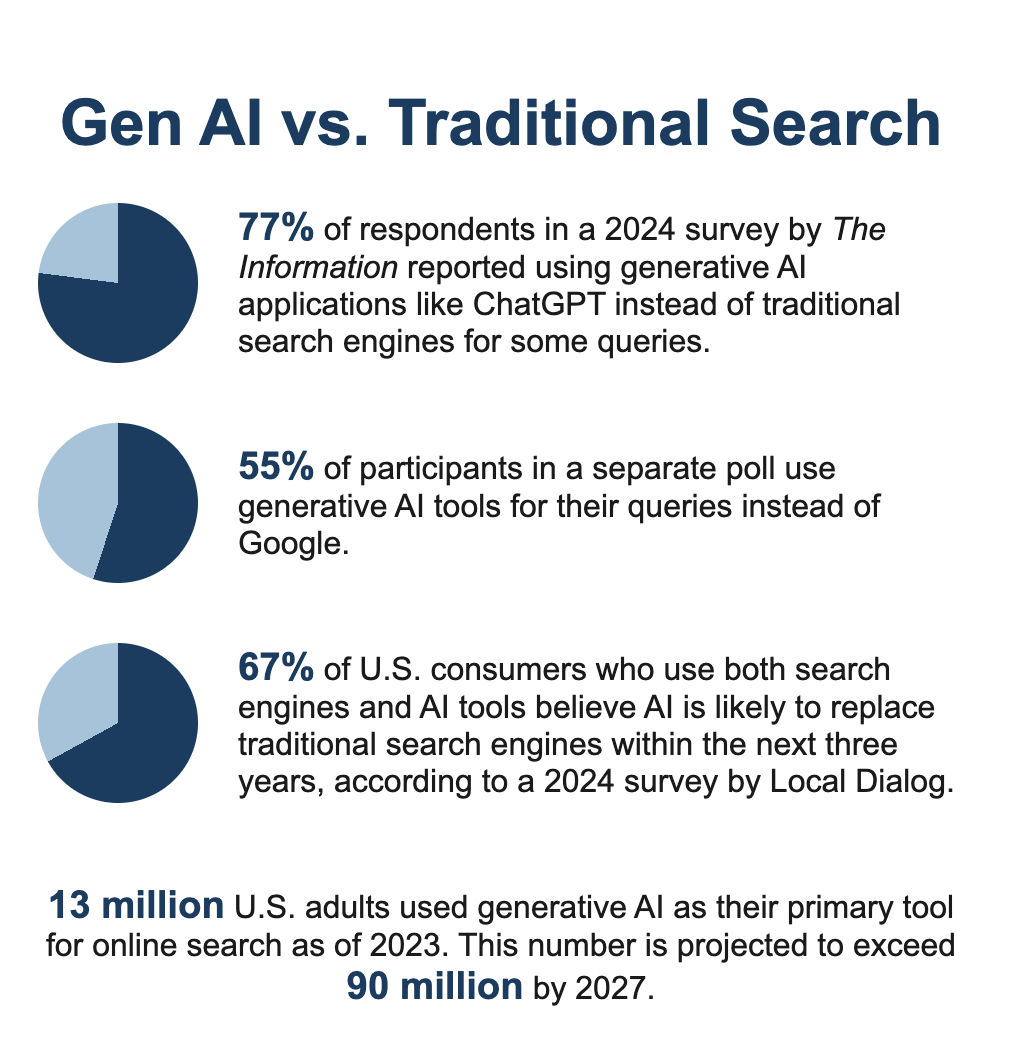
    • 77% of respondents in a 2024 survey by The Information reported using generative AI applications like ChatGPT instead of traditional search engines for some queries. [¹]
    • 55% of participants in a separate poll indicated they use generative AI tools for their queries instead of Google. [¹]
    • 67% of U.S. consumers who use both search engines and AI tools believe AI is likely to replace traditional search engines within the next three years, according to a 2024 survey by Local Dialog. [²]
    • 13 million U.S. adults used generative AI as their primary tool for online search as of 2023. This number is projected to exceed 90 million by 2027. [³]

    🔮 Future Projections

    • 25%Gartner predicts that by 2026, traditional search engine volume will decrease by 25%, with AI chatbots and virtual agents capturing a significant portion of search queries. [⁴]
    • 69% — By 2030, it's estimated that AI-driven tools could dominate over 69% of information searches, indicating a substantial shift towards AI-based search methods. [⁸]

    👥 Demographic Insights

    • 82% — AI search adoption is highest among younger Americans. For instance, 82% of Gen Z (ages 18–26) have used AI search tools at least occasionally, favoring social media for product discovery. [⁵]
    • 79.8% — Despite the rise of AI tools, 79.8% of consumers still prefer traditional search engines like Google or Microsoft Bing for general information searches. [⁵]

    💡 Implications

    The increasing reliance on AI for search suggests a transformative shift in user behavior, with potential impacts on industries reliant on search engine traffic. As AI tools become more integrated into daily life, businesses and content creators may need to adapt their strategies to maintain visibility and engagement.

    For brands, this shift means traditional SEO strategies must evolve. When AI is the intermediary between your brand and consumers, visibility depends not just on ranking well in search results but on being a trusted source that AI models reference.

    At Spotlight, we help businesses understand how AI talks about their brand and industry.
    Our platform analyzes the sources AI models reference when discussing your products or services, enabling you to craft strategies that ensure your brand remains visible in an AI-dominated information landscape.


    📚 Sources

    1. TechRadar: People are increasingly swapping Google for the likes of ChatGPT, according to a major survey
    2. StanVentures: The Search Revolution – How People Are Finding Information In 2025
    3. Statista: U.S. generative AI usage for online search forecast
    4. Gartner: Gartner Predicts Search Engine Volume Will Drop 25% by 2026
    5. Search Engine Land: AI search gaining traction but not replacing Google
    6. GWI: AI and search engine trends
    7. Exploding Topics: AI Statistics
    8. Morningscore: Will AI Grow Bigger Than Google Search?