Tag: ai search optimization

  • H1 Tag SEO: A Complete Guide for Search in 2026

    H1 Tag SEO: A Complete Guide for Search in 2026

    The most repeated advice about H1 tags is also the least useful: “Use one H1 with your exact keyword and you're optimized.”

    That's outdated. A good H1 still matters, but not because it acts like a ranking cheat code. It matters because it tells people, crawlers, screen readers, and now AI systems what the page is about. In practice, H1 tag SEO has shifted from tactical keyword placement to clear semantic labeling.

    That shift changes how content teams should work. If your H1 is vague, stuffed, or disconnected from the rest of the page, you make the page harder to interpret. If it's clear, aligned with the title tag, and supported by a clean heading hierarchy, you give both search engines and AI summarization systems a better shot at understanding the page correctly.

    Table of Contents

    Why Your H1 Tag Matters More Than You Think

    The old myth says the H1 is a major ranking lever on its own. The evidence no longer supports that framing.

    What still holds true is that the H1 is one of the clearest ways to define a page's topic. It's not a strict requirement for ranking by itself, but it remains one of the strongest page-level signals for what the document is about when it's used well. That matters for SEO, accessibility, and AI-driven summarization.

    A lot of teams still overinvest in the wrong part of H1 optimization. They debate exact-match phrasing, force awkward wording, and treat the heading like a place to stuff search terms. That usually weakens the page. A robotic H1 doesn't help readers trust the content, and it doesn't improve the broader structure that modern systems use to interpret meaning.

    The real job of the H1

    A strong H1 does three jobs at once:

    • Sets topic expectation: It tells a visitor what they're about to read.
    • Supports structure: It anchors the hierarchy that H2s and H3s build underneath.
    • Improves machine interpretation: It gives crawlers and AI systems a high-confidence label for the page's main subject.

    Practical rule: Treat the H1 as the page's top-level topic statement, not as a keyword container.

    H1 tag SEO becomes more important in 2026, not less. Traditional ranking impact may be less rigid than people think, but semantic clarity matters more because content now needs to be understood not only for indexing, but for extraction, summarization, and citation.

    What works and what doesn't

    What works is simple: write a heading that clearly names the page topic in natural language and matches the rest of the content.

    What doesn't work is writing something like “Best H1 Tag SEO Keyword Strategy for H1 Tag SEO Success” and expecting that repetition to send a stronger signal. That style belonged to an older search era. Today, the better move is clarity, consistency, and usable structure.

    Understanding the H1's Semantic Role

    An H1 is the main heading of the document. That sounds basic, but the important part is semantic, not visual. An H1 isn't just bigger text. It's a structural signal that tells systems, “this is the main topic of the page.”

    A hand-drawn illustration depicting an open book labeled H1, explaining the semantic importance of H1 tags for SEO.

    Think of the H1 as the book title

    The easiest way to explain it to a content team is with a book analogy.

    The H1 is the book's title. Your H2s are the main chapters. Your H3s are the sub-sections inside those chapters. If the book title is unclear, every chapter underneath it becomes harder to interpret. The same thing happens on a webpage.

    That structure matters to more than Googlebot. Screen readers rely on heading markup to help people move through content quickly. A clean heading hierarchy lets someone jump to the section they need instead of listening to the entire page line by line. When teams use headings only for styling, they break that experience.

    According to Moz's guide to H1 tags, Google and other search engines use the H1 as a strong page-level signal for the document's main topic, but it isn't a strict ranking requirement. Pages can still rank with multiple H1s or even no H1s if the content satisfies intent and is well structured.

    Why semantics matter in practice

    That flexibility is where people get confused. They hear “Google can rank pages without an H1” and conclude that H1s don't matter. That's the wrong takeaway.

    An H1 still reduces ambiguity. It helps a crawler classify the page faster. It helps a reader confirm they landed in the right place. It helps assistive technologies present the page properly. And in AI search environments, it gives models a clean opening signal about the document's central topic.

    Here's what a semantic H1 does well:

    • Names the topic directly: “H1 Tag SEO Guide for 2026” is clearer than “Everything You Need to Know.”
    • Matches user intent: The heading should reflect what the page answers.
    • Supports hierarchy: The sections below should logically expand the promise of the H1.

    A poor H1 usually fails in one of two ways. It's either too generic to be useful, or it's overloaded with keywords in a way no person would naturally write.

    A heading can be technically valid and still be strategically weak.

    That's the distinction teams need to understand. Semantic usefulness is the standard now.

    The Evolution of H1 Tags in SEO

    H1 guidance only makes sense if you understand the history. A lot of bad advice survives because it was once directionally right in a very different search environment.
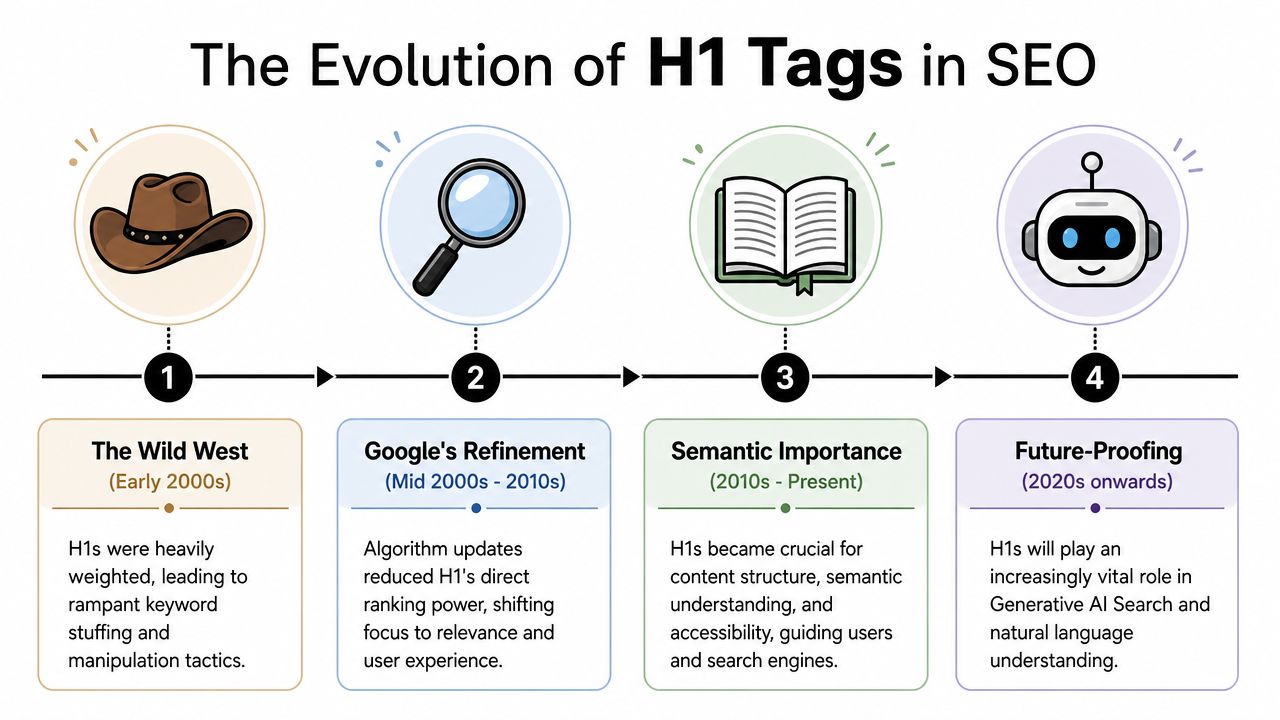
    An infographic showing the historical evolution of H1 tags in SEO from the 2000s to the future.

    What changed from old SEO to modern SEO

    In the early era of SEO, teams treated the H1 as a high-value ranking element. That led to predictable abuse. Marketers stuffed exact-match keywords into H1s, repeated phrases unnaturally, and often wrote headings for algorithms instead of people.

    Google's evolution changed that.

    As documented in Moz's H1 experiment and discussion of Google guidance, John Mueller said in 2019 that a site can rank well with no H1 tags or with five H1 tags, and that multiple H1s are normal in HTML5. The same Moz analysis also reported no statistically significant ranking difference between pages using H1s and H2s for titles. That was a major correction to the old one-H1-or-fail mindset.

    The takeaway isn't that structure stopped mattering. It's that strict H1 formulas lost direct ranking importance as search systems became better at understanding context, semantics, and intent across the full page.

    The H1 used to be treated like a shortcut. Now it works more like a label in a larger system of meaning.

    That larger system includes body copy, internal linking, title tags, schema, layout, supporting headings, and the overall coherence of the document. Teams that still optimize H1s in isolation are solving the wrong problem.

    What that means for teams today

    The modern best practice is more flexible, but also less forgiving of sloppy writing. You don't need to obsess over rigid old-school rules. You do need a heading that makes sense for humans and fits the rest of the page.

    For technical teams working across templates, CMS limitations often create the actual H1 problems. Theme output, component libraries, and page-builder defaults can all introduce structural noise. If you're thinking about AI search readiness, this broader foundation matters as much as the headline itself. A useful companion read is this guide to technical foundations for ranking on AI search.

    The shift is simple. Old SEO asked, “Did we place the keyword in the H1?” Modern SEO asks, “Is the page easy to understand at a glance?”

    How to Write an Optimized H1 Tag in 2026

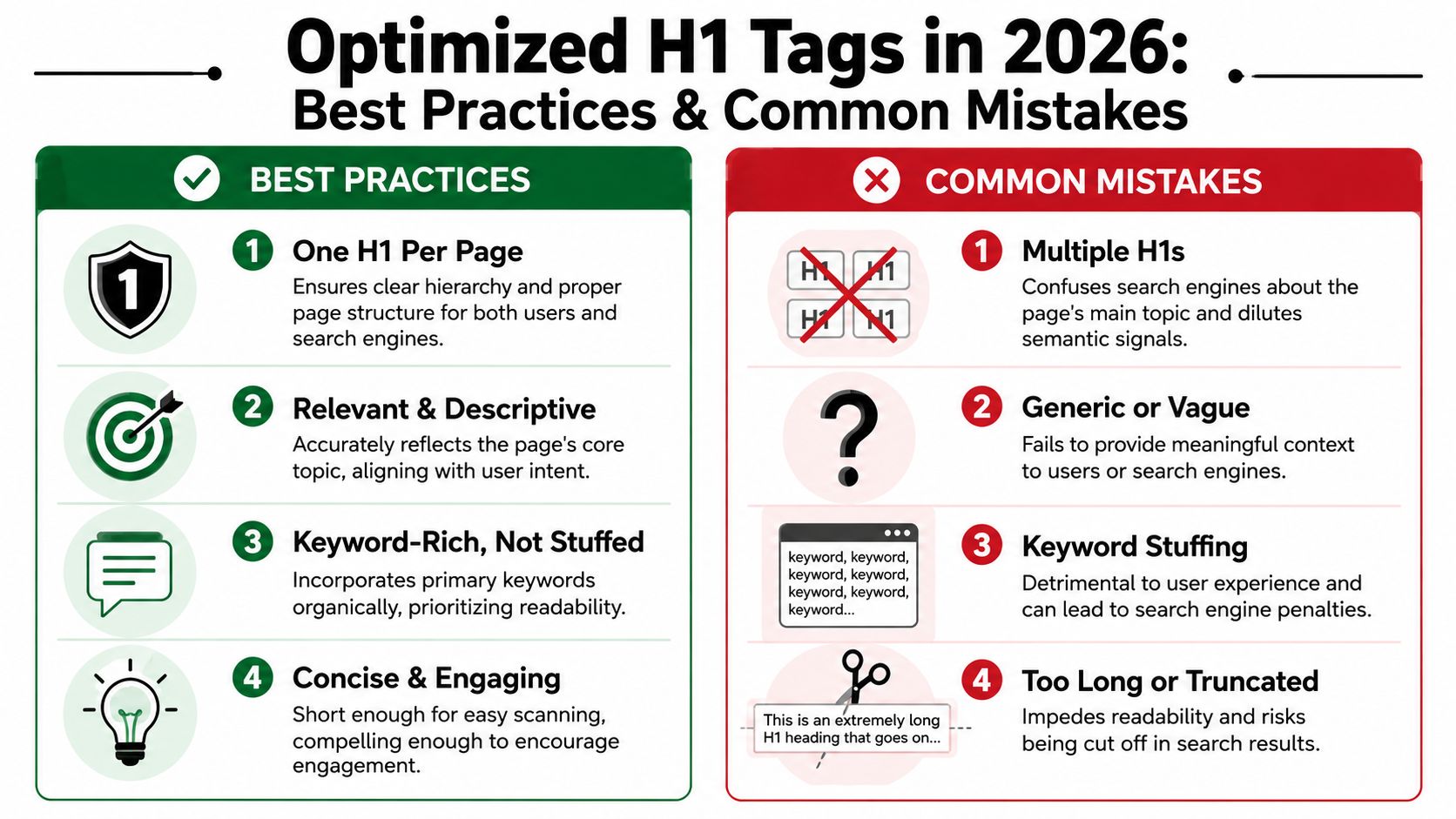
    Most H1 advice is either too rigid or too loose. The practical middle ground is better. Use one clear H1 in most cases, write it in natural language, align it with the page title and topic, and make sure the section hierarchy underneath it is clean.
    An infographic outlining best practices and common mistakes for optimizing H1 tags for SEO in 2026.

    A useful data point supports that approach. A 2026 Rankability case study on H1 usage found that 93.5% of top-ranking pages used a single H1 tag, but it also found a negligible correlation of −0.0282 between rank and partial keyword match in the H1. That's the clearest summary of modern H1 tag SEO I've seen. Top pages usually use one H1, but keyword matching inside the H1 doesn't show meaningful ranking power on its own.

    The modern H1 checklist

    Use this as an editorial standard.

    • Write for topic clarity: The H1 should tell a first-time visitor exactly what the page covers. If someone can't understand the subject from the heading alone, rewrite it.
    • Keep it aligned with the title tag: It doesn't have to be identical, but it should describe the same topic in closely related language.
    • Include the primary keyword naturally: If the main phrase fits, use it. If exact-match wording sounds forced, choose the clearer version.
    • Use one H1 on most pages: HTML5 allows more flexibility, but one main heading still creates the cleanest structure in most CMS environments.
    • Make the supporting hierarchy logical: H2s should break the main topic into major sections, and H3s should sit under the relevant H2s only.

    For teams managing enterprise CMS environments, implementation often matters as much as copy. If you work in Sitecore or SharePoint, Kogifi on Sitecore and SharePoint SEO is a practical reference because these platforms often create heading issues through templates rather than through editorial intent.

    A simple implementation example

    Here's the pattern you want:

    <h1>H1 Tag SEO Guide for Search in 2026</h1>
    <h2>Why H1s Still Matter</h2>
    <h2>How to Write a Strong H1</h2>
    <h3>When to Use the Primary Keyword</h3>
    <h2>Common Mistakes</h2>
    

    And here's the pattern you want to avoid:

    <h1>SEO</h1>
    <h3>Tips</h3>
    <h2>H1 Tag SEO H1 Tags Best SEO H1</h2>
    

    The first example creates a usable outline. The second creates confusion.

    If you want a good editorial test, read the H1 and all H2s without reading the body copy. If the outline feels coherent, you're probably in good shape. That same principle also supports AI extraction, because readable structure makes the page easier to summarize accurately. This is one reason teams focused on AI visibility also care about readability levels that win GEO and AEO citations.

    Don't chase perfect keyword symmetry. Chase clear topical alignment.

    That's what works now.

    Common H1 Tag Mistakes and How to Fix Them

    Most H1 problems aren't conceptual. They're operational. A CMS strips the heading. A template outputs multiple H1s. A designer uses an H1 for a logo. A writer publishes a clever headline that says nothing.

    The fix is usually straightforward if you look at the page like a structure problem, not just a copy problem. As noted by MarTech's H1 best practices overview, the highest-value pattern is keeping the H1 semantically aligned with the page's title and primary keyword while maintaining a clean H1 → H2 → H3 hierarchy so crawlers and accessibility tools can interpret the content properly.

    H1 Tag Error Correction Guide

    Mistake Why It's a Problem How to Fix It
    Missing H1 The page has no clear top-level topic marker Add one visible main heading that accurately describes the page
    Multiple H1s from a theme or builder The page may present several competing main topics Keep one primary H1 and convert the others to H2 or styled text
    Logo wrapped in H1 on every page The site brand becomes the main heading instead of the actual page topic Reserve the H1 for the page title, not the header logo
    Vague heading such as “Welcome” or “Resources” Users and crawlers get little context about the page's purpose Replace it with a descriptive phrase tied to actual intent
    Keyword-stuffed H1 The heading reads unnaturally and weakens usability Rewrite it in plain language and keep only the relevant phrasing
    H1 misaligned with title tag The page sends mixed signals about the main topic Bring the title tag and H1 into close topical alignment
    Heading levels skipped below the H1 The outline becomes harder for assistive tools and crawlers to interpret Use a logical order, starting with H2 for major sections
    Hidden H1 used only for SEO Users see one message while the markup signals another Use a visible H1 that matches the page's true topic

    A quick review standard

    When reviewing pages, ask three questions:

    • Can a human identify the topic instantly
    • Does the heading outline make sense in order
    • Does the page promise match the page content

    If the answer to any of those is no, the H1 probably needs work.

    H1 Tags and the Future of AI Search

    The next phase of H1 tag SEO isn't about ranking formulas. It's about interpretation quality.
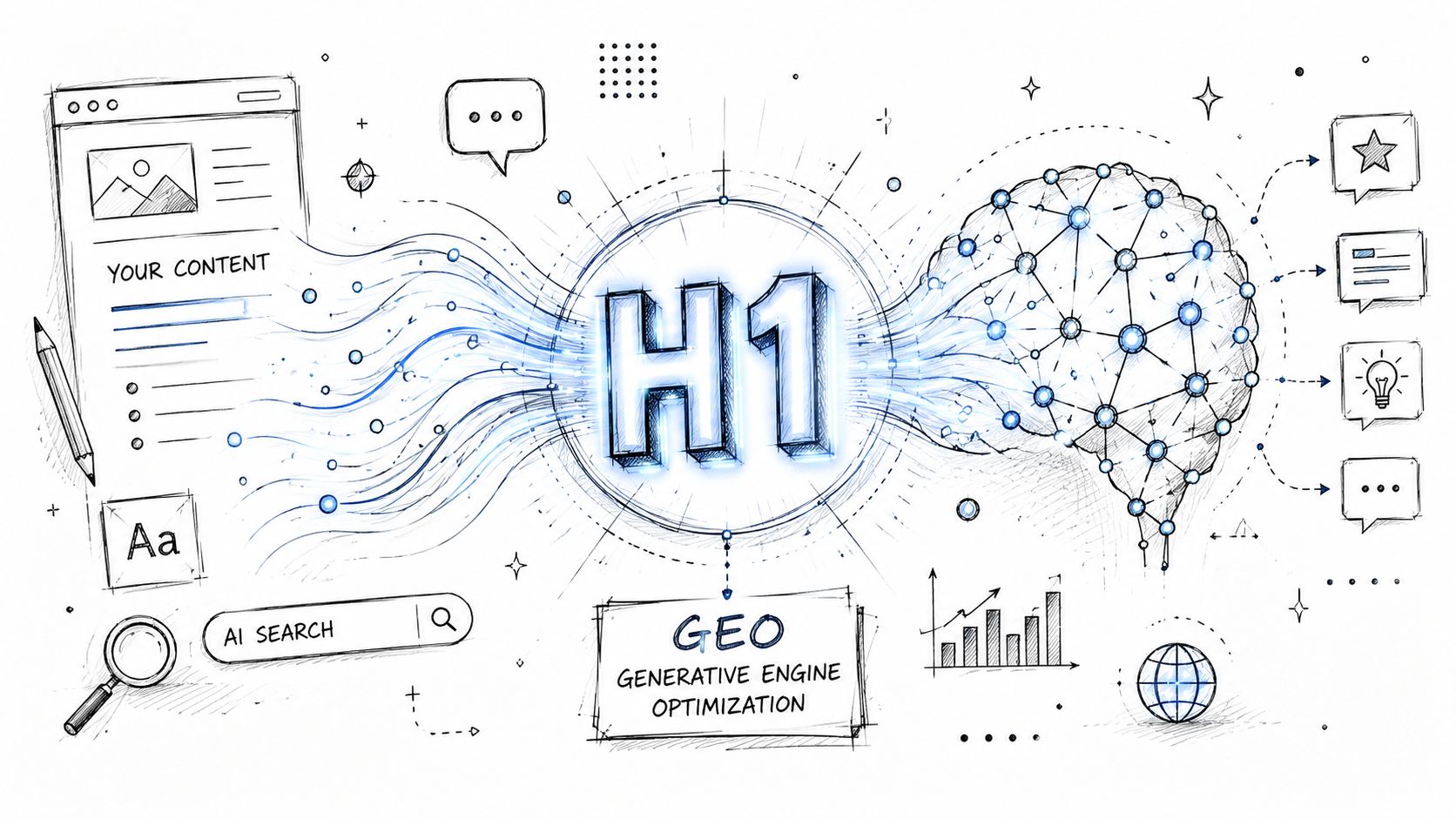
    A conceptual illustration showing how content connects through H1 tags to generative AI engines for optimization.

    AI search systems don't read pages the way a person does. They parse, compress, and assemble meaning from multiple signals. In that process, the H1 functions like a high-priority label for what the document is trying to say. If the label is vague, bloated, or disconnected from the content below it, the system has to infer more. That increases the risk of a weak summary or a bad citation context.

    Why AI systems care about H1 clarity

    The old “exact match everything” advice breaks down. The more useful question is whether your H1 makes the page easy to summarize accurately.

    According to Mangools' discussion of H1 SEO, guidance is inconsistent on whether the H1 still needs exact-match keyword optimization. Many pages rank well with more natural, user-first H1s, which suggests that over-optimizing the H1 is less valuable than aligning it with the overall page structure for AI and user clarity.

    That matches what content teams are seeing in practice. Cleanly written headings tend to support cleaner extraction. Messy headings force models to reconcile conflicting signals from titles, intros, subheads, and body copy.

    If a model has to guess what your page is about, your H1 has already failed its first job.

    What to optimize for now

    For AI search and generative engine optimization, a strong H1 should do four things:

    • Name the subject plainly: Use the language your audience expects, not brand-speak.
    • Match the content underneath: Don't promise a guide if the page is a product page, and don't label a comparison page like a tutorial.
    • Support likely summaries: If an AI system had to describe your page in one sentence, the H1 should help it get that sentence right.
    • Reduce ambiguity across templates: This is especially important in CMS-heavy sites and WordPress builds where theme issues can damage semantic structure. For teams cleaning that up, this guide to avoiding WordPress SEO errors is useful because many heading problems start in templates, not in copy.

    AI visibility work also benefits from understanding how content gets interpreted and reused by generative systems more broadly. This article on search engine optimization using AI is a good next read if your team is connecting on-page SEO to GEO strategy.

    The H1 hasn't become more powerful because of keyword weighting. It has become more strategic because more systems now depend on fast, reliable topic extraction.

    Frequently Asked Questions About H1 Tags

    What's the difference between a title tag and an H1

    The title tag is the page title that typically appears in search results and browser tabs. The H1 appears on the page itself as the main visible heading. They should usually be closely aligned, but they don't have to be identical word for word.

    Should you use emojis or special characters in an H1

    Usually, no. A few brands can make it work, but most pages benefit from plain language. Special characters often make headings look less professional and can distract from the core topic signal.

    What's the fastest way to audit H1 tags across a site

    Use a crawler such as Screaming Frog to export heading data at scale, then spot-check key templates in the live browser. Also inspect the rendered HTML, because page builders and JavaScript can create heading problems that aren't obvious in the editor.


    Spotlight Group LLC helps brands understand and improve how they appear across AI search platforms. If your team wants to see where models mention your brand, which prompts trigger those mentions, and what content earns citations, Spotlight Group LLC is built for that workflow.
  • Top 10 Ecommerce SEO Best Practices for AI Search

    Top 10 Ecommerce SEO Best Practices for AI Search

    Google still treats ecommerce as a crawling and indexing challenge, not just a copywriting challenge. Its own Search Central ecommerce guidance puts structured data, canonicalization, index control, and complete product detail pages at the center of visibility. That's the surprising part for many teams chasing AI search: before ChatGPT, Gemini, or Perplexity can cite your products well, your catalog has to be machine-readable, internally coherent, and easy to trust.

    That's why traditional ecommerce SEO is now table stakes. The next layer is earning inclusion in AI-generated answers, product comparisons, and recommendation summaries. If you sell online, you're no longer optimizing only for blue links. You're optimizing for extraction, citation, and recommendation. That changes how product pages should be written, how category architecture should be built, and how you measure success.

    The good news is that the underlying disciplines overlap. The same teams that get structured product data right, localize cleanly, and publish strong comparison content tend to be the teams that show up more often in AI responses. The difference is that you now need to think in terms of prompts, citations, and answer engines in addition to rankings and sessions.

    If you're building that bridge now, it helps to pair classic ecommerce fundamentals with AI-specific workflows. That's where modern AI strategies for B2B ecommerce vendors start to matter. The checklist below focuses on what moves the needle for both search engines and AI systems.

    Table of Contents

    1. Optimize Product Pages for AI Search Intent and Citation

    The ecommerce teams that win AI visibility do not publish prettier product pages. They publish clearer ones. If ChatGPT, Gemini, or Google's AI features cannot extract the product facts, trade-offs, and use cases from your page with confidence, your SKU is less likely to be cited in recommendations, comparisons, and shopping answers.

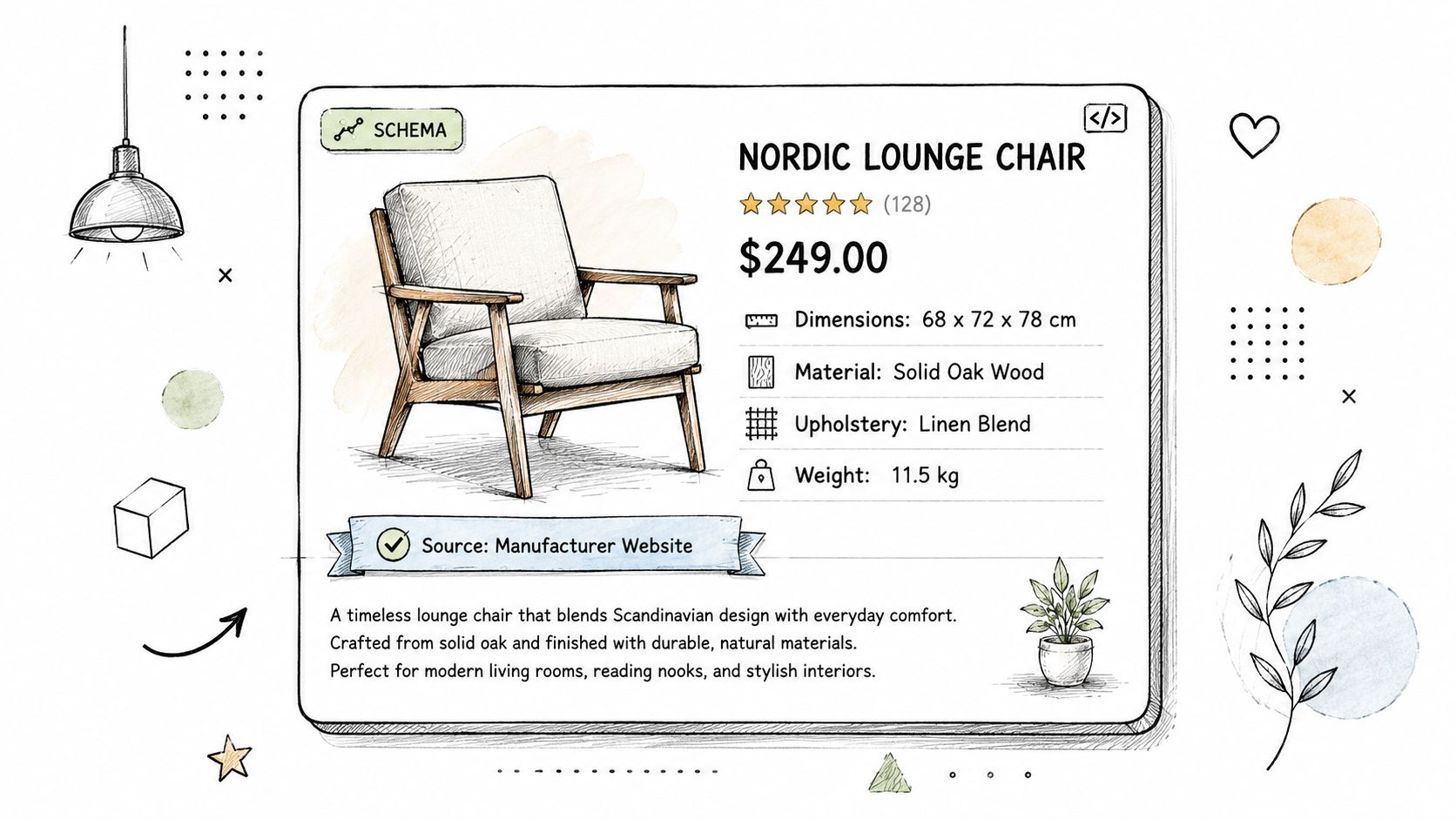
    As noted earlier in Google's guidance, product pages need machine-readable facts that match what users see on the page. The operational problem is usually not missing content. It is scattered content. Specs sit in tabs loaded late, shipping details live in a help center, variant names are inconsistent, and schema no longer matches the offer shown to shoppers.

    ecommerce seo best practices

    What AI systems need from a product page

    AI systems cite pages that answer a product question cleanly. That means the page has to do more than describe the item. It has to state what it is, who it fits, what makes it different, what constraints matter, and what a buyer should know before purchase.

    Retail leaders like Amazon and Best Buy are useful reference points here. Their strongest pages make core facts easy to parse in plain HTML, and they reduce ambiguity around compatibility, included parts, delivery timing, and return expectations. That improves conversion. It also improves the odds that an AI system can reuse the page as a citation instead of looking elsewhere.

    A product page built for citation usually includes:

    • Exact product naming: Put the brand, model, size, color, and variant details in the title and near the top of the page.
    • Readable specs: Publish dimensions, materials, compatibility, SKU, GTIN, and included components in crawlable HTML, not only in images or buried accordions.
    • Decision support: Answer common pre-purchase questions directly on the page, especially fit, setup, maintenance, and usage limits.
    • Commercial clarity: Keep price, availability, shipping windows, and returns consistent across visible copy, feeds, and schema.
    • Clear differentiation: State the trade-offs. If the product is lighter, quieter, cheaper, or more durable than alternatives, say so plainly.

    One test works well. Ask whether the page can support an AI answer to: “What is this product, who is it for, why would someone choose it, and what should they know before buying?” If any part is vague, the page is underprepared for GEO.

    For teams treating this as a measurable channel, citation tracking matters more than rank tracking alone. Spotlight's free GEO and AEO tools for agencies focused on AI search optimization are useful for checking whether product URLs appear in AI-generated answers by market and prompt type.

    One caution. Longer copy does not automatically produce more citations. In practice, pages with sharper facts, stronger attribute coverage, and clearer buyer-fit language often outperform pages padded with generic feature text.

    2. Implement Geo-Specific Content for Multi-Market AI Visibility

    A product page that works in the United States often underperforms in Canada, the UK, or Australia even when the core SKU is identical. The copy may be technically translated, but the page still feels wrong for the market. AI systems pick up that mismatch fast because prompts often contain regional context.

    The fix isn't just changing currency. Strong multi-market pages localize terminology, sizing, shipping expectations, return language, and payment context. Uniqlo-style regional storefronts work because they don't pretend one version of the catalog fits every audience.

    Localization that helps citation, not just translation

    The most common mistake is publishing duplicated local pages with only light edits, then leaving search engines to sort out the intended market. That confuses traditional search and AI citation alike. Hreflang, canonical logic, and market-specific copy need to work together.

    If you're testing this operationally, tools for geo validation matter as much as the pages themselves. Spotlight's regional testing workflow is useful for teams that want to see how AI visibility changes by country, and its roundup of free geo and AEO tools for agencies focused on AI search optimization is a practical starting point.

    Use geo pages to make local realities explicit:

    • Market language: “Trainers” and “sneakers” shouldn't fight on the same regional page.
    • Commercial context: Show local payment methods, duties, shipping windows, and returns where relevant.
    • Regulatory clarity: Surface region-specific compliance details when they affect purchase decisions.
    • Local availability: Don't let a global template imply a product can ship everywhere if it can't.

    When ecommerce brands get this right, AI systems have a cleaner choice about which market page to cite. When they get it wrong, the model often falls back to a third-party source that explained the local context better.

    3. Build Authority Through Content That AI Models Naturally Citation

    If you want AI systems to mention your brand in product recommendations, generic blog content is a weak bet. Models cite pages that resolve a question cleanly, show clear selection logic, and give enough specifics to summarize without guessing.

    That changes the content brief.

    Instead of publishing broad guides built to chase volume, build pages around decision moments. The pages that earn citations usually help a user compare options, choose based on constraints, or understand fit before purchase. On ecommerce sites, that often means buying guides, use-case pages, compatibility explainers, care and maintenance content, and side-by-side comparison pages drawn from your own catalog knowledge.

    Wirecutter-style structure works because it exposes reasoning. A model can extract who a product is for, where it falls short, and why an alternative may be better for a different buyer. Brand content should do the same, but with tighter product expertise and cleaner commercial context.

    For GEO, authority is less about sounding polished and more about being quotable. The strongest pages make claims in a format AI systems can reuse: clear headings, explicit criteria, concise summaries, and evidence that comes from real product knowledge rather than filler copy.

    Build your content mix around citation-friendly intents:

    • Choice support: “How to choose the right trail running shoe for rocky terrain”
    • Use-case guidance: “Best office chair materials for 8-hour sitting”
    • Constraint-based recommendations: “Best strollers for small car trunks”
    • Comparison content: “Hybrid mattress vs memory foam for hot sleepers”
    • Compatibility answers: “Which water filter fits older Brita pitchers”

    The trade-off is operational. Thin content is faster to produce, but it rarely becomes the source an AI assistant trusts for a recommendation. Citation-focused content takes merchandiser input, customer support insights, and product-level detail. It also tends to perform better across both classic SEO and AI discovery because it answers the exact question instead of circling it.

    I've found the highest-yield workflow is to mine the questions your team already hears. Pull from on-site search, pre-sales chat logs, returns reasons, support tickets, and review themes. Then turn those into pages with a clear point of view and direct recommendation criteria. If the page could help a shopper make a choice even after reading only the AI summary, it is built on the right standard.

    Measurement matters here too. GEO content should be tracked by whether it gets cited, paraphrased, or used in AI comparison answers, not only by organic sessions. Teams using platforms like Spotlight can monitor which pages show up in AI-generated responses by prompt type, then expand the formats that keep getting referenced.

    If reviews are part of the evidence base behind these pages, connect the workflow to collection. Review Overhaul's review solutions can help teams generate more detailed customer feedback, which gives comparison and use-case content stronger proof instead of recycled brand claims.

    4. Leverage Product Reviews and User-Generated Content for AI Credibility

    AI systems are conservative when product claims look one-sided. Pages with only brand-authored benefits and no customer proof feel less trustworthy than pages that include reviews, Q&A, and visual evidence from real buyers.

    That doesn't mean review quantity alone wins. What helps most is specificity. A review that says a running shoe felt stable on long pavement runs is more useful than a review that says “Great product.” The same goes for apparel, furniture, skincare, and electronics. Details make reviews extractable.

    ecommerce seo best practices

    Turn reviews into structured proof

    Google recommends keeping product page signals aligned with visible content and explicitly highlights details such as price, availability, reviews, shipping, and returns. OuterBox also summarizes that the most important structured fields often include product name, brand, SKU or GTIN or MPN, price, currency, availability, aggregate ratings, shipping and return details, and variant relationships in its guide to ecommerce SEO strategies.

    That's why review handling should be operational, not cosmetic:

    • Collect reviews that answer real questions: Ask buyers about fit, durability, setup, compatibility, and intended use.
    • Mark them up properly: Use review schema only for actual on-page reviews, not manufactured summaries.
    • Feature useful formats: Photo reviews and comparison comments often add more confidence than star icons alone.
    • Respond when needed: A thoughtful brand response can clarify edge cases, shipping confusion, or usage guidance.

    A lot of brands also underestimate post-purchase workflows. If you want stronger review content, ask better prompts after delivery. For teams reworking that pipeline, Review Overhaul's review solutions are worth examining as an operational model.

    5. Optimize for AI-Specific Search Queries and Natural Language Variation

    Traditional keyword research still matters, but AI prompts expose a layer of demand that standard term lists often flatten. People don't only ask for “best office chair.” They ask for the best office chair for lower back pain in a small apartment, or whether one brand is better than another for all-day work.

    That shift changes page design. You need content blocks that address use case, comparison, constraints, and buyer type directly. Product pages, collection pages, and editorial pages should each absorb a different class of prompt.

    Map prompts to page types

    Industry guidance summarized by Grumspot emphasizes transactional and long-tail keyword targeting, with workflows in Semrush and Ahrefs built around intent, volume, competition, and page mapping. One practical benchmark in that guidance is prioritizing terms with at least 100 monthly searches while treating longer, more specific queries as stronger buying signals, as described in its article on ecommerce SEO best practices.

    That benchmark is helpful, but don't force every conversational prompt into a new page. Most stores need a cleaner map:

    • Category pages for broad commercial demand
    • Filter or collection pages for attribute-led demand
    • Product pages for exact product and variant intent
    • Editorial content for comparisons, use cases, and decision support

    I've found the strongest AI search programs build reusable prompt patterns into templates. They don't treat every new natural-language query as a custom content project. They identify recurring structures like “best for,” “under budget,” “vs,” and “for beginners,” then build pages that can credibly answer them.

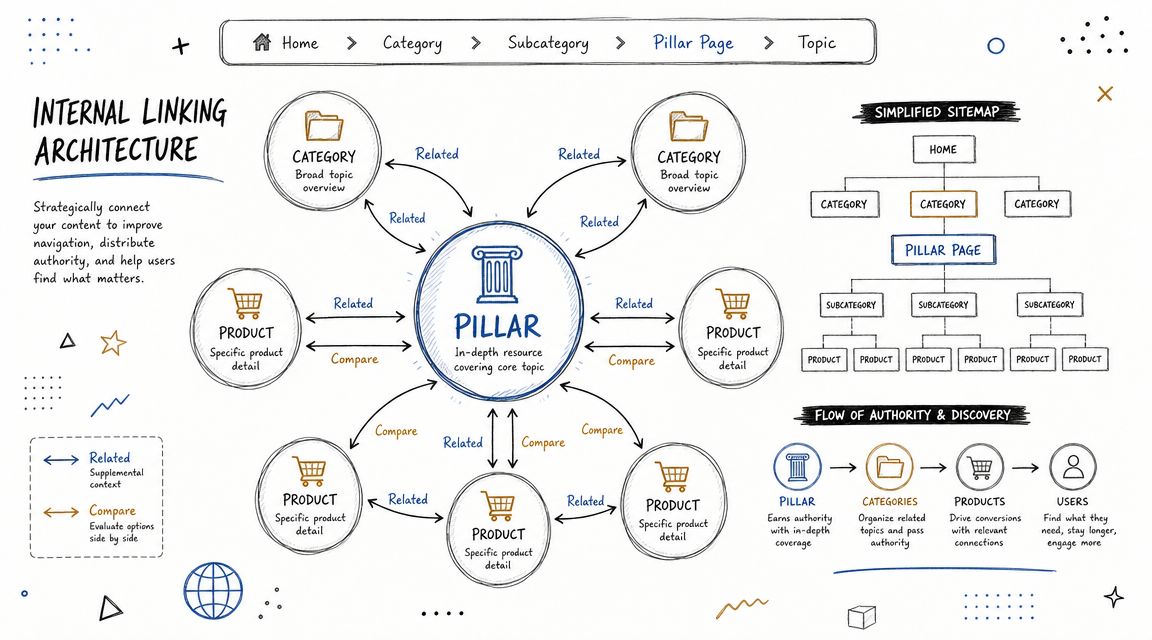
    6. Build Internal Linking Architecture for AI Model Navigation and Understanding

    Internal linking is where many ecommerce SEO best practices either scale or collapse. A well-linked catalog tells a search engine and an AI system how products, categories, and supporting content relate. A poorly linked catalog leaves valuable pages stranded.

    This gets worse as the store grows. Merchandisers launch new categories, filters multiply, seasonal pages appear, and no one revisits the underlying architecture. The result is familiar: orphaned pages, weak category hubs, and random link placement driven by CMS convenience rather than strategy.

    ecommerce seo best practices

    Architecture beats isolated page optimization

    Amazon's category hierarchy remains the reference example because it links products, subcategories, alternatives, and related behavior patterns in a coherent way. You don't need Amazon's scale to borrow the principle. Every important product type should sit inside a clear hub-and-spoke structure.

    A practical internal linking pass usually includes:

    • Repair orphaned URLs: Make sure priority products are linked from relevant category and subcategory pages.
    • Strengthen breadcrumbs: Breadcrumbs clarify hierarchy for users and machines.
    • Link to decision content: Product and category pages should connect to buying guides and comparisons where that helps the shopper.
    • Use descriptive anchors: “Men's waterproof trail running shoes” is better than “shop now.”

    The best internal links don't just pass authority. They explain the catalog.

    There's a trade-off here too. Teams sometimes overlink every page to every other page in the name of discoverability. That muddies hierarchy and weakens signal clarity. Better architecture is selective. It shows which paths matter most.

    7. Optimize Page Speed and Technical SEO for AI Crawler Efficiency

    Fast pages help shoppers, but they also help machines process your site with less friction. If templates are bloated, critical content loads late, or key product data depends on fragile client-side rendering, you're increasing the chance that search engines and AI systems get an incomplete picture of the page.

    Technical SEO remains foundational because ecommerce sites produce a lot of complexity by default. Variant URLs, faceted parameters, pagination, and seasonal inventory churn can create thousands of weak or duplicate pages quickly. That's why Google's guidance treats canonicalization and index control as core ecommerce work, not cleanup work.

    Technical hygiene that affects discoverability

    The pages most likely to cause trouble are often not the ones teams watch most closely. They're filtered listings, internal search pages, expired products, and parameter combinations that create thin duplicates.

    A disciplined technical pass should cover:

    • Render essential content in accessible HTML: Don't hide core product facts inside scripts when you can avoid it.
    • Control duplicate paths: Use canonical tags and noindex rules where pages don't deserve independent visibility.
    • Keep mobile templates clean: Many crawlers and users encounter the mobile experience first.
    • Audit faceted navigation: Parameters should serve user discovery without creating uncontrolled index sprawl.

    One hard truth in ecommerce is that better content can't rescue a catalog the crawler can't interpret cleanly. Before you chase new GEO experiments, make sure your technical base isn't subtly suppressing the pages you most want cited.

    8. Create Competitor Analysis Content That AI Models Use for Comparisons

    Comparison content is one of the clearest bridges between classic SEO and AI search. Users ask models direct judgment questions all day long: which laptop is better for students, which espresso machine is easier to maintain, what's a good alternative to a premium brand.

    If your site never addresses those questions, the model will source the answer elsewhere. Usually from publishers, marketplaces, forums, or review sites that were willing to make the comparison you avoided.

    Comparison pages need editorial judgment

    The best comparison pages don't read like sales pages with two logos pasted at the top. They define the buyer, the use case, and the trade-offs. PCPartPicker and Capterra-style experiences work because they help a shopper decide, not because they mention competitors more often.

    Useful comparison content should include:

    • A clear scenario: Better for travel, better for gaming, better for beginners, better for wide feet.
    • Objective criteria: Specs, compatibility, limitations, maintenance, support, or setup complexity.
    • Honest negatives: If your product is stronger in one context but weaker in another, say it.
    • Recommendation logic: Explain who should choose which option and why.

    Many in-house teams often hesitate at this point. Legal or brand teams may worry about naming competitors. But if buyers are already asking AI systems for that comparison, silence doesn't protect your brand. It just hands the narrative to someone else.

    9. Monitor and Respond to Brand Mentions in AI Systems Through Citation Tracking

    AI visibility can drift long before revenue does.

    A brand can keep ranking for category terms while losing share inside ChatGPT, Gemini, and other answer engines because the model stopped citing its pages, started citing a competitor more often, or picked up the wrong framing from reviews, reseller listings, or third-party commentary. If you only watch sessions and rankings, you see the lagging signal. Citation tracking gives you the earlier one.

    AI systems do more than mention a URL. They summarize your brand position. They decide whether you are premium or overpriced, beginner-friendly or complex, credible or interchangeable. Those descriptions shape consideration before the click.

    For ecommerce teams shifting from classic SEO to GEO, the job is to monitor three things at once: whether your brand appears, which sources the model cites, and how the model describes you. Spotlight's guide to tracking brand mentions in AI chatbots is a useful operational reference for building that workflow, and its analysis of which schema markup types appear in AI-cited websites helps connect mention tracking to the on-page signals that often support citation.

    A workable review process usually includes:

    • Prompt sets by intent: Separate discovery, comparison, post-purchase, and problem-solving prompts. Models often cite different sources for each.
    • Brand versus competitor share: Track where rivals appear in answers and cited links, especially for “best,” “alternative,” and “vs” queries.
    • Narrative patterns: Save recurring phrases tied to your brand, products, pricing, quality, and support experience.
    • Source diagnosis: Check whether the model is pulling from your site, retailers, forums, review publishers, or outdated pages.
    • Response priorities: Fix pages that feed bad summaries first. Usually that means product detail pages, FAQs, comparison content, and review surfaces.

    The trade-off is straightforward. Manual prompt checking gives useful qualitative insight, but it breaks down fast across markets, product lines, and prompt variations. Platform-based tracking is better for trend detection and competitor benchmarking, but it still needs human review because citation presence alone does not tell you whether the model framed your brand well.

    Offsite reputation also matters here. If AI systems keep surfacing third-party commentary ahead of your own pages, understanding how brand mentions SEO works helps tie GEO monitoring to digital PR, review generation, and publisher outreach.

    Treat citation tracking as a weekly operating rhythm, not a quarterly audit. The goal is not just more mentions. It is better mentions, from better sources, in the prompts that influence buying decisions.

    10. Integrate Structured Data and Schema Markup for AI Model Understanding

    Structured data gives AI systems a cleaner read of your catalog. On ecommerce sites, that affects more than rich results. It shapes whether a model can identify the product, connect it to the right offer, and pull the same facts your team wants surfaced in AI answers.

    Accuracy matters more than volume. Schema should confirm what the page already states in visible copy. If your markup says a product is in stock, priced at one amount, or tied to a specific rating while the page says something else, you create conflicting signals. That weakens trust for search engines, AI systems, and buyers.

    The priority is straightforward. Mark up the facts that change buying decisions and citation quality:

    • Product schema for product identity, including name, brand, SKU, GTIN, or MPN
    • Offer or AggregateOffer markup for price, currency, and availability
    • Review and rating schema where real customer feedback exists
    • Shipping, returns, and merchant policy details when those terms influence purchase confidence
    • Variant relationships so size, color, or model versions are understood as related options, not separate duplicate pages

    This is where implementation discipline matters. Many teams publish schema once, then let feed updates, merchandising edits, or frontend changes break it. A strong setup includes recurring validation, ownership between SEO and engineering, and alerts for mismatches between page content and markup.

    For GEO, the trade-off is practical. Schema alone will not get a product cited by ChatGPT or Gemini if the page lacks useful content, reviews, or brand authority. But clean markup improves machine readability, reduces ambiguity, and gives AI systems more confidence in the core facts they summarize. Teams tracking AI visibility in platforms like Spotlight should connect schema changes to citation movement by page type, product line, and query pattern, especially after large catalog updates.

    Use schema to remove guesswork. Then keep it synchronized so your product data stays citation-ready.

    10-Point AI-Focused Ecommerce SEO Comparison

    Strategy Implementation complexity Resource requirements Expected outcomes Ideal use cases Key advantages
    Optimize Product Pages for AI Search Intent and Citation Medium, content + schema updates Content writers, developers, analytics integration Higher AI citations and qualified traffic in 2–4 weeks Ecommerce product listings seeking AI referrals Improves AI citation likelihood and traditional SEO simultaneously
    Implement Geo-Specific Content for Multi-Market AI Visibility High, multiple localized versions Regional content teams, localization tools, infrastructure Increased regional AI citations and international traffic in 8–12 weeks Multi-country ecommerce with distinct markets Greater local relevance and regulatory compliance
    Build Authority Through Content That AI Models Naturally Cite High, research and long-form production Research resources, expert contributors, content team Strong, frequent AI citations and enduring credibility (weeks) Brands aiming for thought leadership and unique insights Defensible authority and high citation rates
    Leverage Product Reviews and User-Generated Content for AI Credibility Medium, collection and markup Review platforms, moderation, schema implementation More AI citations and higher conversion rates (weeks) Consumer brands with active customers Social proof boosts AI trust and conversions
    Optimize for AI-Specific Search Queries and Natural Language Variation Medium, prompt-driven content changes Prompt analysis tools, content optimization resources 3–5x higher citation rates for conversational queries Brands targeting question-driven purchase intent Targets real AI prompts with lower competition
    Build Internal Linking Architecture for AI Model Navigation and Understanding Medium, site audit and restructure SEO audit, content updates, developer support Better AI understanding and discoverability in 4–6 weeks Large catalogs and content-rich sites High impact on topical relevance with relatively low effort
    Optimize Page Speed and Technical SEO for AI Crawler Efficiency Medium–High, technical optimizations Developers, performance tooling, CDN Faster crawling and more consistent AI citations (2–4 weeks) Sites with heavy JS or slow load times Foundation for crawlability, UX, and AI access
    Create Competitor Analysis Content That AI Models Use for Comparisons Medium, structured comparison content Competitive research, content templates, updates Higher citations for comparison queries; traffic from alternatives Markets with many comparable products Captures high-intent comparison traffic and trust
    Monitor and Respond to Brand Mentions in AI Systems Through Citation Tracking Low–Medium, tool setup and workflows Citation tracking tool, analysts, reporting Faster detection of citation shifts and actionable insights Brands monitoring AI reputation and performance Real-time visibility to inform rapid strategy changes
    Integrate Structured Data and Schema Markup for AI Model Understanding Medium, technical markup work Developers, schema validators, QA Improved citation accuracy and rich results (weeks) Sites with products, reviews, and FAQs Machine-readable content that boosts AI extraction and accuracy

    From Checklist to Competitive Advantage

    The phrase “ecommerce SEO best practices” can sound stale because the basics have been common knowledge for years. Research keywords. Write product copy. Fix technical issues. Add schema. Improve speed. None of that is wrong. It's just incomplete now.

    What changed is the surface area of discovery. Your brand no longer competes only for rankings in a conventional SERP. It competes for inclusion in AI-generated answers, follow-up recommendations, product comparisons, and conversational shopping journeys. That doesn't replace classic SEO. It raises the standard for it.

    The strongest ecommerce teams are treating SEO and GEO as one operating system. They don't separate “ranking work” from “AI work” because the underlying requirements overlap. Clean product entities, strong category structure, selective indexation, credible reviews, comparison content, and market localization all make the site easier for machines to understand. Once that foundation is in place, AI citation becomes a measurable extension of good ecommerce execution rather than a mysterious black box.

    The underserved opportunity is selective depth. Most stores still spread effort too evenly across the catalog. They optimize thousands of pages lightly instead of identifying the pages and page types most likely to influence both search and AI recommendations. That usually means top category pages, high-margin products, comparison pages, and localized market pages. Those assets deserve stronger copy, cleaner data, better internal links, and active measurement.

    Faceted navigation is a good example of where old habits need updating. Many teams still default to blocking filters broadly because they're worried about duplication. The more practical approach is selective indexation based on real demand. Major Tom's discussion of faceted navigation in ecommerce SEO points to the right operational question: which filter combinations deserve visibility because shoppers search for them? When you answer that with demand data, not fear, filter pages can become some of the best assets in the catalog for high-intent discovery.

    If you need a starting point, don't start with everything. Start with your top product pages. Tighten the facts, strengthen the schema, add decision-support copy, and make sure price, availability, shipping, and returns are easy to extract. Then monitor how those pages appear across AI systems. After that, move into comparison content, localized pages, and faceted page governance.

    That's how this becomes a competitive advantage instead of another audit document. You pick the pages that matter, make them easier for machines to trust, and measure whether models cite them. Over time, that compounds into stronger visibility in both traditional search and AI-driven commerce.


    Spotlight Group LLC helps SEO, content, and growth teams turn AI search from a black box into a measurable channel. If you want to see where ChatGPT, Gemini, Perplexity, Claude, Copilot, Grok, AI Overviews, and AI Mode mention your brand, which prompts trigger those mentions, and which sources models cite, Spotlight Group LLC gives you the workflow to monitor, prioritize, and improve that visibility.

    Crafted with Outrank tool