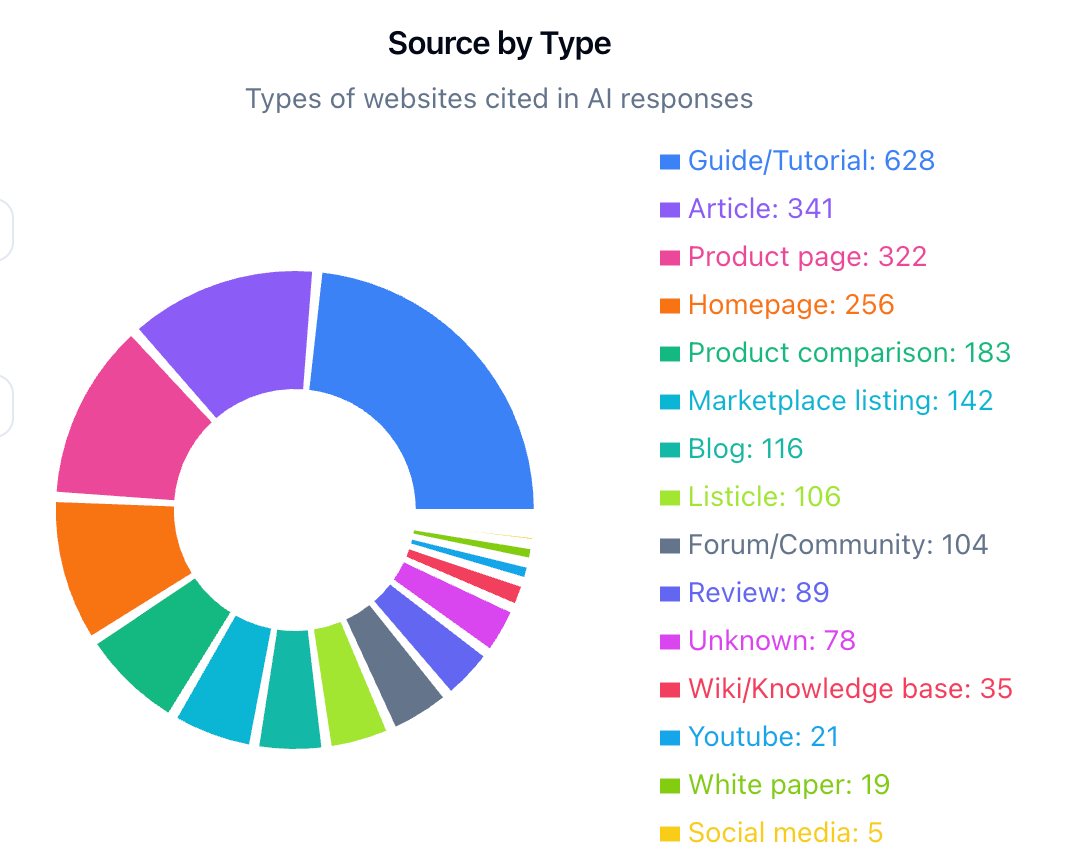
This analysis is based on data from Spotlight’s database, which tracks how different LLMs cite content in their responses. We analyzed:
- 1,684 source analyses from Gemini 2.0 Flash, examining detailed content characteristics
- 1.2+ million response links from 8 different LLMs (ChatGPT, Gemini, Perplexity, Claude, Copilot, Grok, AIO, and AIMode)
- Content preferences across visual elements, structure, depth, and source types
The Universal Content Preferences
Our analysis reveals that LLMs have remarkably consistent preferences when it comes to content types. Here’s what we found across all models:
LLM-Specific Content Preferences
Total Citations: 290,493
Top Preference: Wikipedia dominates with 20,309 citations (7% of all ChatGPT citations)
ChatGPT shows the highest preference for .org domains (10.29%) and academic sources, suggesting a preference for authoritative, well-sourced content.
Content Type Breakdown:
- Guide/Tutorial content: 12.45%
- Blog content: 11.23%
- Listicle format: 12.19%
Total Citations: 445,176 (highest among all LLMs)
Top Preference: Reddit dominates with 13,614 citations
Perplexity shows the strongest preference for user-generated content and social platforms, with Reddit, YouTube, and Google Play Store being top sources.
Content Type Breakdown:
- Blog content: 17.95%
- Guide/Tutorial content: 14.66%
- Listicle format: 9.10%
Total Citations: 328,134
Top Preference: Google Play Store with 3,745 citations
Gemini heavily favors Google’s own properties and services, with Google Play, YouTube, and Google’s AI search being top sources.
Content Type Breakdown:
- Guide/Tutorial content: 14.89%
- Blog content: 16.87%
- Listicle format: 9.31%
Total Citations: 460 (smallest dataset)
Top Preference: Wise.com with 26 citations
Claude shows a strong preference for UK-based financial services and consumer advice sites, with 37.61% of citations from .co.uk domains.
Content Type Breakdown:
- Guide/Tutorial content: 23.70%
- Blog content: 22.17%
- Listicle format: 15.22%
Total Citations: 10,450
Top Preference: Amazon with 568 citations
Copilot shows the strongest preference for e-commerce platforms, with Amazon, Walmart, and Target being top sources.
Content Type Breakdown:
- Listicle format: 14.99%
- Blog content: 13.07%
- Guide/Tutorial content: 11.03%
Total Citations: 2,566
Top Preference: X.com (formerly Twitter) with 732 citations
Grok shows the highest preference for .com domains (81.49%) and heavily favors its parent company’s platform, X.com.
Content Type Breakdown:
- Blog content: 12.98%
- Guide/Tutorial content: 10.68%
- Listicle format: 5.07%
Content Characteristics That Matter Most
Based on our analysis of 1,684 source analyses from Gemini 2.0 Flash, here are the content characteristics that appear most frequently in LLM-cited content:
| Characteristic | Percentage | What This Means |
|---|---|---|
| Images Present | 95.13% | Visual content is nearly universal in cited content |
| Uses Bullet Points | 90.62% | Structured, scannable content is preferred |
| Visual Data (Images/Videos) | 78.80% | Multimedia content is highly valued |
| Author Credentials | 74.76% | Credibility and expertise matter |
| Uses Opinions | 64.85% | Subjective insights are valued alongside facts |
| Corporate Website | 61.28% | Official brand sources are heavily cited |
| Signs of Agenda | 60.27% | Content with clear purpose/intent is preferred |
| Fresh Content | 57.78% | Recent information is valued |
| Highlighted Keywords | 48.34% | SEO-optimized content performs well |
| FAQ Sections | 35.39% | Question-and-answer format is effective |
The Content Depth Sweet Spot
Our analysis reveals that LLMs prefer content that’s neither too shallow nor too deep:
Only 4.28% of cited content is classified as “in-depth,” while 5.29% is “surface-level.” This suggests that LLMs prefer content that provides substantial information without being overwhelming.
Visual Content: The Universal Language
Visual content appears to be the most consistent preference across all LLMs:
- 95.13% of cited content contains images
- 10.45% contains videos
- 78.80% has some form of visual data
The average cited content contains 9.3 sections and 83 paragraphs, with an average length of 2,820 characters.
Domain Preferences by LLM
Each LLM shows distinct domain preferences that reflect their training and purpose:
| LLM | Top Domain Preference | % of Citations | Characteristic |
|---|---|---|---|
| ChatGPT | en.wikipedia.org | 7.0% | Academic, authoritative |
| Perplexity | reddit.com | 3.1% | User-generated, social |
| Gemini | play.google.com | 1.1% | Google ecosystem |
| Claude | wise.com | 5.7% | UK financial services |
| Copilot | amazon.com | 5.4% | E-commerce focused |
| Grok | x.com | 28.5% | Social media native |
- Visual content is essential: 95% of cited content contains images, making visual elements nearly universal in LLM-preferred content.
- Structure matters: 90% of cited content uses bullet points or lists, indicating a strong preference for scannable, organized information.
- Moderate depth wins: 71% of cited content is “moderate” depth – not too shallow, not too deep.
- Credibility counts: 75% of cited content shows author credentials, emphasizing the importance of expertise.
- LLMs have distinct personalities: Each LLM shows unique preferences reflecting their training and purpose (ChatGPT loves Wikipedia, Perplexity favors Reddit, etc.).
- Corporate content dominates: 61% of cited content comes from corporate websites, suggesting official brand sources are highly valued.
Practical Implications for Content Creators
Based on this analysis, here’s what content creators should focus on to improve their chances of being cited by LLMs:
1. Visual Content Strategy
- Include images in 95%+ of your content
- Consider adding videos to 10%+ of content
- Ensure visual elements support and enhance the text
2. Content Structure
- Use bullet points and lists extensively (90%+ of content)
- Organize content into clear sections (average 9.3 sections)
- Keep paragraphs manageable (average 83 paragraphs per piece)
3. Authority and Credibility
- Showcase author credentials and expertise
- Include empirical evidence when possible
- Cite sources and provide evidence
4. Content Depth
- Aim for “moderate” depth – comprehensive but not overwhelming
- Target 2,000-3,000 characters per piece
- Balance thoroughness with accessibility
5. Platform-Specific Optimization
- For ChatGPT: Focus on authoritative, well-sourced content similar to Wikipedia
- For Perplexity: Create engaging, social-friendly content that sparks discussion
- For Gemini: Optimize for Google’s ecosystem and services
- For Claude: Consider UK-focused content and financial services
- For Copilot: Focus on e-commerce and product-related content
While LLMs show distinct preferences based on their training and purpose, there are universal content characteristics that improve citation likelihood across all models. Visual content, structured presentation, moderate depth, and clear authority signals appear to be the most important factors for LLM citation success.
As AI continues to evolve and new models emerge, understanding these preferences becomes crucial for content creators looking to optimize for AI visibility. The data shows that the future of content optimization isn’t just about search engines—it’s about understanding how AI models consume and cite information.
This analysis is based on data from Spotlight’s database, which tracks LLM citations across multiple AI models. The data represents real-world citation patterns from over 1.2 million analyzed links.